
Tips for Continuous Improvement to Your Nonprofit's Website
If you want to set your nonprofit website up for long-term success, taking a continuous improvement approach is your best bet. Find out why and how here.
Guest Post by Anne Stefanyk at Kanopi Studios
These days, the internet changes rapidly. There are new tools, platforms, and best practices that come to light every day. Because of this, waiting for a large website overhaul project is no longer the recommended route when it comes to site maintenance.
So, what does this all mean for your nonprofit’s website and online marketing efforts?
Here at Kanopi, we work with a wide range of organizations to help them develop and maintain a successful website. We’ve found that the best nonprofit websites are those that take a continuous improvement approach to maintenance. This approach is much more valuable, especially for their sites’ long-term health.
What is a continuous improvement approach to website maintenance?
Traditionally, organizations would create their website, design it, develop it, and then push it live. It was a very straightforward and linear process, that often resulted in a “set it and forget it approach.” Basically, after launch, the site risked being neglected, with the result being a large redesign and optimization project taking place a few years later to update the site again.
Hopefully, you would update the website’s systems and tools to the most recent version, refresh content and copy to be up-to-date, ensure that all pages and series were in working order, and more. However, these large maintenance projects also cost a lot of money and could take up to 6-12 months depending on their scope, leaving a large amount of time where the site is not up-to-par.
With the modern evolution of the current online world, it’s actually much more beneficial to think of the website development process as circular instead of linear, reflecting a more continuous improvement approach.
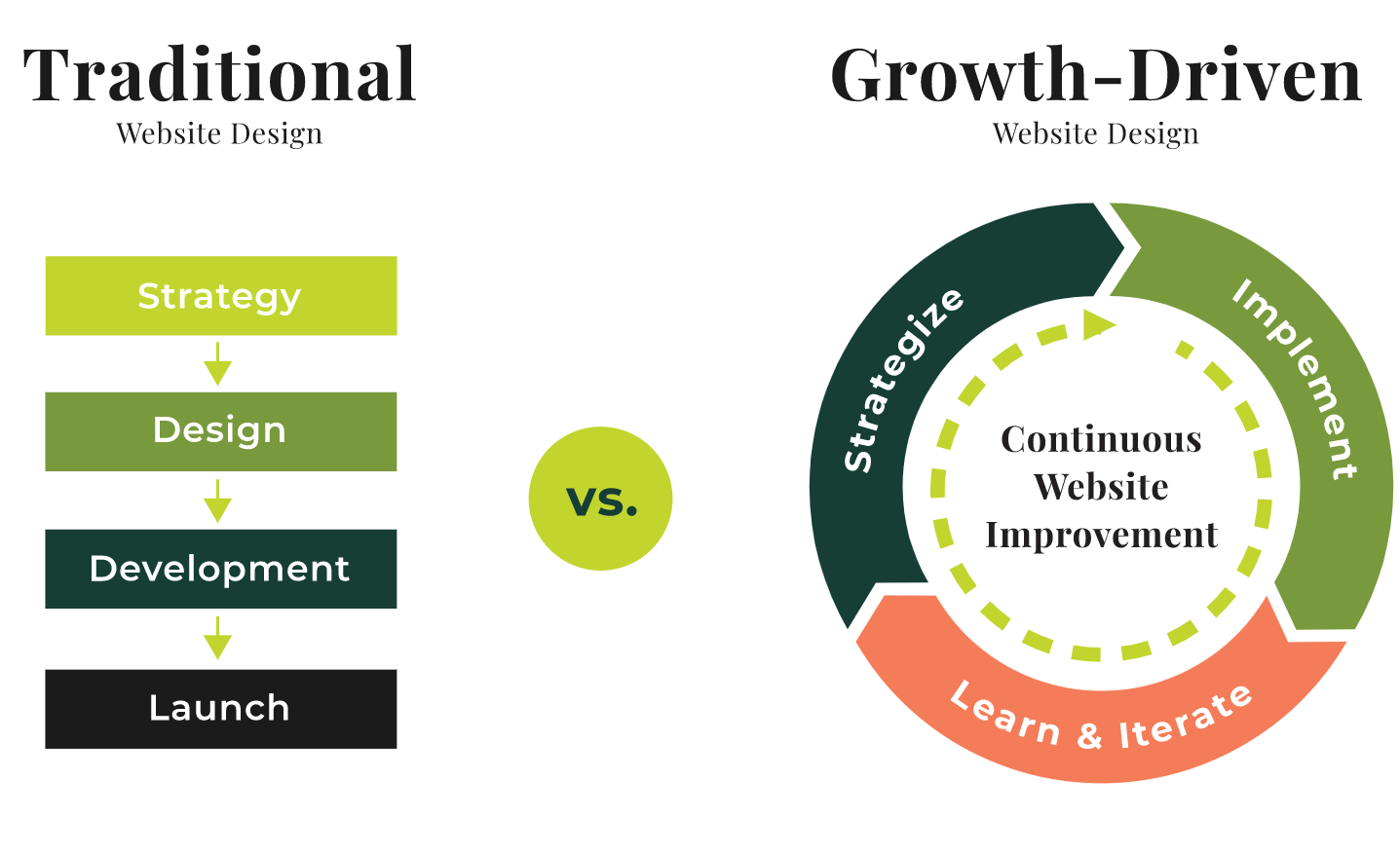
This Kanopi article on how to make a website last states: “Don’t think about your site in terms of Strategy > Design > Development > Launch, and then let it sit untouched for a while… Instead, think of a circular process of Strategy > Implement > Learn & Iterate, where after you Iterate, you revisit Strategy again! This will translate into a site that is always being refreshed and improved without breaking the bank.”
Here are some other benefits of taking a continuous improvement approach:
All of your website’s plugins, modules, and integrated tools are up-to-date and work seamlessly with each other
Your website is always fully accessible and compliant with all relevant laws
Users can more easily explore your website, learn about upcoming projects, and access your services
Every aspect of the donor journey, like mission research on your website, is seamless
You’ll see increased online conversions, like gifts, event registrations, and volunteer signups
You’ll set your nonprofit website up for long-term success, as your website health is much stronger when it’s constantly updated
Making small, minor tweaks on a more consistent and ad-hoc basis is more manageable time-wise and labor-wise than dedicating a large chunk of time to updating everything. And, this way there won’t be moments where users visit your site to learn something new and instead are met with outdated information or even broken pages or links.
When does your website need improvement?
So, now that you know why a continuous improvement approach to your nonprofit website is essential and how it can benefit your organization and goals, when exactly do you make those critical updates?
It’s not hard to determine exactly when your website could use a little love. Here is a list of questions to ask yourself:
Has your organization or mission evolved?
Do any of your software, tools, apps, modules, or plugins need updating?
Has your industry evolved? Are there any recent news updates you should share?
Can your users find what they are looking for? How navigable is your website?
Have your website visitors’ needs changed? Garner feedback through an email survey for more insight.
Is your content presented clearly? Is anything confusing?
Is your conversion rate declining? This can be the rate for online fundraising, event registrations, or any other organizational goals.
Have your search engine rankings changed? Has your landing pages’ bounce rates increased?
Have other similar nonprofit organizations changed their approach?
Is your site fast enough? A page speed of under 2-3 seconds is recommended.
Does your site look great on mobile devices? Is it compliant with other accessibility laws?
Is your site easy to use and edit? Can different staff members access and update content quickly and as needed?
If you answered yes to any of these questions, then it’s a good sign that your website could use some quick maintenance. Taking care of these needs immediately rather than waiting until the last minute is much more beneficial not only to your site’s health but also to your supporters’ user experience.
What are some website maintenance continuous improvement best practices?
Ready to start taking a continuous improvement approach to your nonprofit’s website maintenance? Here are some additional tips that we recommended:
Do a SWOT analysis of your website. This will help outline any strengths, weaknesses, opportunities, and threats you have to your site.
Map out user journeys to see how different users navigate through your site. Determine the different pathways they take and how you can improve your website to better align with these pathways.
Do a complete site audit to determine if your content is old or if there’s anything you need to update or archive.
Review major site components like your page architecture, overall design, site performance, and more.
Make small tweaks like removing links that people don’t click on, or archiving old content.
The most important part of your website maintenance plan is to always be open to learning and improving. As you continue to update and tweak your site, you’ll learn a little more about what works and what doesn’t.
Make it a habit to measure your site’s health and do data checks on a regular basis. You can even schedule user testing to make sure that your website is consistently meeting supporter needs. Work with your team to set up sprints to integrate this feedback into your site.
Wrapping Up
If you want to make your website last and ensure that your mission is a high priority, taking a continuous improvement approach to maintenance is your best bet. Don’t let your online engagements fall to the wayside and pile up your maintenance tasks to do at the last minute.
If you need any more guidance on how to track your website’s health and the small tweaks you should make, contacting a technology consultant for nonprofits can help.
About the Author:

As Founder and CEO of Kanopi Studios, Anne helps create clarity around project needs, and turns client conversations into actionable outcomes. She enjoys helping clients identify their problems, and then empowering the Kanopi team to execute great solutions.
Anne is an advocate for open source and co-organizes the Bay Area Drupal Camp. When she’s not contributing to the community or running her thoughtful web agency, she enjoys yoga, meditation, treehouses, dharma, cycling, paddle boarding, kayaking, and hanging with her nephew.
https://twitter.com/Anne_Kanopi

Using Google Grants Across Fundraising Streams: 3 Tips
Making the most of your organization’s Google Ad Grant across multiple fundraising platforms is crucial to reaching your engagement goals. Here’s how nonprofits of all sizes can diversify their revenue streams and specifically maximize the impact of their Google Grants.
Guest post by Grant Hensel, CEO of Nonprofit Megaphone
Nonprofit organizations are renowned for their ability to achieve great things with limited resources. Despite having tax-exempt status, being a nonprofit requires the pursuit of stable revenue streams. Often, this takes the form of fundraising. Successful nonprofits have a diverse range of fundraising activities, ensuring that their revenue isn’t tied to the success or failure of one particular venture.
Even if an organization has conducted a successful fundraising campaign for many years, these campaigns can stagnate. Stagnation, or the fear of stagnation, requires that nonprofit professionals find new ways to enhance and promote their fundraising efforts.
At Nonprofit Megaphone, we help nonprofit organizations share their mission with the world. To do this, we help organizations acquire, maintain, and utilize the Google Ad Grant. The Ad Grant is a cost-effective way for nonprofits to participate and thrive in digital marketing. While the Grant can be employed to achieve numerous goals, many of our clients use the Grant to boost the performance of various fundraising streams.
Simply put, the Google Ad Grant is an opportunity available to eligible nonprofits that give them a monthly allocation of Google advertising dollars. With the Grant, your organization will run Google Ads, which are sponsored links that appear in relevant web searches. These links are valuable, as your team can use them to drive traffic to your website. Further, using the Grant is often more efficient than traditional marketing, as you can use the data provided by Google to tweak and modify your ads for better results. We recommend the Google Ad Grant because it’s a cost-effective way to meet nearly any fundraising, marketing, or communications goal.
With our experience, we have three tips that will help you use the Google Grant to enhance your fundraising strategy:
Use KPIs To Determine Future Fundraising Strategies
Optimize Your Email Outreach
Build Out Content In Your Website To Make The Most Of Your Google Ad Grant
Use KPIs To Determine Future Fundraising Strategies
There are many ways for your organization to raise funds. However, determining which are worth your time and resources is a crucial strategic decision. Whether you’re looking to enhance your current strategies or looking for a new venture, a data-driven approach will be to your advantage.
The Google Ad Grant gives you access to a full suite of data and analytics tools in the Google Ads interface. Further, Google Ads easily integrates with Google Analytics, allowing you to analyze the performance of your ads in addition to your overall website performance. Using this data, you can identify where you’re having fundraising success and where you may be able to benefit from future investment.
Important metrics are called Key Performance Indicators. What qualifies as a KPI depends on your organization and its priorities, but there are a few important metrics for nearly every Google Ads Account.
Impressions
Impressions are one of the most common metrics in Google Ads. An impression is registered every time an ad appears in a Google Search. Impressions can tell you a lot about your ad’s performance but often need other metrics to see the bigger picture.
Strong impressions may indicate that your ad is relevant to a highly-searched topic, an essential part of any Google Ad campaign. However, if those impressions don’t lead to clicks, conversions, or other engagement metrics, it indicates that your Ad copy isn’t enticing enough. Even with good corresponding engagement metrics, low impressions may signify that the topic can only reach a narrower audience.
Clicks
A click is registered whenever someone clicks on your Google Ad and is taken to your website. As one of the most basic engagement metrics, clicks are an indicator of ad success. As such, tweaking your ads to generate more clicks is always a good thing. It’s also important to be mindful of your ad’s Click-Through Rate. This number is generated by dividing the number of clicks your ad generates by its impressions. Google requires that you maintain a 5% or greater CTR throughout your account. A higher CTR shows that your ads are operating efficiently, targeting the right audience and enticing them to engage with your organization.
Conversions
Of all engagement metrics, conversions are the grand prize. A conversion is registered any time a user makes an action of value on your website. In the context of fundraising, the act of making a donation, purchase, or other transaction would be a notable conversion. Using Google Analytics, you can set up conversion tracking and get detailed information about how users interact with your website.
In conjunction with Google Ads, you can learn which ads directly lead to fundraising conversions and prioritize those campaigns. With these KPIs, you’re able to learn more about your fundraising audience and what’s important to them. You can also gain insights into which audiences and topics should be targeted for future fundraising campaigns.
Optimize Your Email Outreach
Email outreach is an integral part of any marketing or communications campaign. Having a base of engaged email subscribers allows you to easily broadcast updates and opportunities to those who support your organization. Further, a solid foundation of email outreach can bolster existing fundraising streams and help launch new ones. There are a few ways the Google Ad Grant can help you grow your email list and identify what these users want from your organization.
Successful campaigns will track conversions that harvest email data. Your team can do this in a few ways but most commonly, in the form of a newsletter. Newsletters are a great way to spread your message, but also to keep stock of your engaged supporters. The Google Ad Grant can help grow your email list by driving users to pages where a newsletter sign-up is a prominent Call To Action on the page.
You can also gather email addresses in a few indirect ways. For example, you could require an email for other conversions that happen on your website. These conversions include:
Making a purchase
Downloading a file
Registering for an event
Users who make these conversions are unlikely to be dissuaded by entering their email address beforehand. Attaching email submissions to conversions is an efficient way to use your Google Ad Grant and enhance the overall effectiveness of your website.
Build Out Content In Your Website To Make The Most Of Your Google Ad Grant
Successful users of the Google Ad Grant have one thing in common: they consistently produce high-quality content that their audience wants to engage with. High-quality content is content that engages, interests, and is easily presented to a user. It leaves a mark in a user’s mind, often leading them to make a conversion or return to your site in the future.
Any site will benefit from high-quality content, but the Google Ad Grant can help drive traffic to the content. This increases the overall efficiency of producing content and gives you opportunities to introduce yourself to new users.
Good content will make users more likely to make conversions, some of which may be connected to valuable fundraising streams or necessary programs. Finally, the Google Ad Grant can give you a way to expand your audience by producing content that appeals to trending keywords or an underserved portion of your existing audience.
What constitutes high-quality content will differ between organizations depending on size, mission, or scope. However, things like videos, podcasts, and infographics are great candidates. For some organizations, users are looking for written content like blogs, essays, or Frequently Asked Questions. The key to producing high-quality content is identifying what your users want and presenting it to them in an easy, satisfying way.
Successful nonprofits will have a diverse set of programs and fundraising streams. This allows them to adapt, change, and grow as conditions develop in their communities. However, getting the most out of these strategies requires an investment in marketing to grow and maintain their audience.
The Google Ad Grant is an affordable and flexible way to maximize the value of your nonprofit’s existing investments. Taking advantage of the advertising provided by the Google Ad Grant allows your organization to identify better where your fundraising streams are having the most success and where further investment is necessary. If your organization is running successfully but wants to maximize efficiency, consider applying for the Google Ad Grant yourself or by consulting a marketing agency.
About the Author:

Grant Hensel is the CEO of Nonprofit Megaphone, an agency focused 100% on Google Grant Management for nonprofits. NPM is honored to manage the Google Grant for 370+ leading nonprofits worldwide and to be an inaugural member of the Google Ad Grant Certified Professionals community.

Nonprofit Marketing: 3 Tips for Tuning in to Donors
Tuning into your donor base has a host of benefits for your marketing strategies. Find out three helpful tips for doing this task in the most effective way.
For nonprofit teams, communicating with potential supporters about how they can get involved is obviously very important to the survival of the nonprofit organization - but sometimes, it can be difficult to know where to start. Grant Cobb, Head of Marketing and Analytics at GivingMail, dives in with three actionable tips for maximizing impact in your nonprofit communications.
Looking for the best way to reach your target audience? When promoting your organization with a cohesive marketing strategy, you’ll want to tune into what you know about your donors already to connect with them effectively.
This may seem like a challenge to undertake as an organization. However, you already have most of the information you need to make intelligent decisions for your marketing strategy. GivingMail knows that marketing for nonprofit organizations helps your team gain access to invaluable engagement data and can help you make even more targeted appeals and outreach content.
Ready to simplify the process of tuning into your donors for a more pointed marketing strategy? Let’s unpack the following tips:
Use your data to create donor segments.
Offer multiple ways to get involved.
Track your donor engagements per platform.
We’ll start with one of the essential sources for learning more about your donors, using your database to create donor segments.
Use your data to create donor segments.
Donor segmentation is the process of dividing your existing constituents into subgroups according to shared traits.
This practice is essential for tuning into your donor base and understanding your audience to the best of your ability. You can use these groups to determine trends and insights from the best outlet for sending out targeted communications to the opportunities that excite different groups.
Luckily, a lot of this information is available in your CRM and the donor profiles within your donor database. However, many nonprofits struggle with finding somewhere to start. After all, you hold a large amount of information on your database. Here are some categories to begin your segmentation process with basic demographics:
Age
Household size
Location
Interests
This way, you can begin to make crucial insights according to what may interest them. You’re able to determine which outreach will resonate with them and predict further actions. For example, if your donor is located in your area, you can send them information about in-person events that they can easily attend.
Once you have basic information about your constituents, you can start to tune into how they have directly engaged your organization. Take note of the following types of questions:
How do they give to your organization?
How did they find out about your organization?
Have they volunteered in the past?
Which campaigns did they give to?
From these helpful insights, you can begin to fine-tune how you reach out to donors and simplify their donor journey based on past giving data. For example, if you determine the most popular route for your donors is through direct mail, you can implement this insight into simplifying their experience.
This way, you can choose the best marketing channels for your target audience.
Based on your social media engagement and messaging information, you can begin to answer the following:
What social media platforms are they using?
Have they replied to any direct mail outreach?
Are they opening your emails?
Again, your organization’s donor segmentation process will be different for every nonprofit, as they’re dependent on how available and in-depth the information is that you collect. Now that you’ve developed helpful subgroups, begin to adjust your marketing strategies as such to resonate with your audience in the best way possible.
Offer multiple ways to get involved.
Your donor data, as mentioned above, can provide crucial insights into how to involve your donors with your mission best. After you’ve nailed down the initial segments by general demographics and involvement, consider the ways donors give to your cause. Then, meet them where they are to maximize their impact on your mission.
To get started, look into your donor’s engagement history in your CRM. Here are a few of the most common ways individuals can engage with your nonprofit:
Monetary donations: These are any sort of cash or online donation. These are the donors you’ll reach out to when hosting an annual fund campaign, are raising money for a specific cause, and anything having to do with writing a check to your organization.
In-kind donations: These donors give valuable products or services to your organization. This can be from a company, an individual, or a trust. For example, if your team is hosting an upcoming charity event, search for product donations or auction items to make the event as successful as possible.
Time: Separate your donors by those who have contributed time to your cause. This group will most likely be the audience you’ll turn to when you are in need of volunteers to show up for your organization in person or virtually to help facilitate a fundraising event or other gathering.
Promotion: Make a note in your donor profiles whenever someone shares your organization’s content on their social media feeds. You’ll know who to depend on if you ever need to ask a group of supporters to promote your posts further to their networks of followers.
By tracking your donors and their engagement history, you can begin to clarify your strategy on meeting them where they are. According to GivingMail, asking for donations should be tactful based on previous engagements. You can even maximize your donations with a few pointed questions like these:
How are you asking for donations?
What are you requesting from each group to push your mission forward?
Who are you asking for support, and why?
When your organization begins to tune into donors based on their willingness and preferences to give, you can easily meet their needs where they are. Let’s get into the final metric to track when making insights about your donors: your platform KPIs.
Track your donor engagements per platform.
Finally, your team can clarify its outreach strategy by paying attention to your social media KPIs. According to these social media insights, social media marketing is a preferred platform for nonprofits due to its cost-efficiency and ease of content distribution to supportersYour team can determine a few things about your donor audience per your social media platforms. Namely, you’ll have an inside look into:
The most popular platform for reaching your audience.
When your donors are seeing your content.
Which outreach methods are most effective for your donors.
As a result, It’s likely that your marketing strategy can most effectively reach donors with a multi-channel approach. To get a better read on your donors and their behaviors, you’ll want to post content on multiple channels for the best results. Let’s take a look at how each platform can help you learn more about your audience:
Instagram: Determine who, where, and when your supporters are interacting with your content. You’re also able to see who views your 24-hour stories and if it’s the most effective way to make quick updates to your audience.
Facebook: This social media platform can alert your organization to who is responding to your Facebook fundraising events most often. More importantly, you’re able to see who is sharing your content to their Facebook feeds and which posts resonate most with those who are sharing.
Twitter: This short-form post social media platform can alert your organization to how quick updates are resonating with your followers. Look into the retweets and favorites on each post and determine if this is an effective route for communicating with donors.
From these KPIs, refine your social media strategy to communicate with donors in the most effective way possible. Be sure to create donor segments based on the most popular social media platforms for your supporters, and plan accordingly to reach them.
When you begin to tune into your donors with the rich and hard-earned data your organization has retained through events, outreach, and online engagements, your team benefits heavily. Use data to create accurate insights about your supporters, clarify your strategy, save time, and meet your donors where they are. Good luck!

Raffle Fundraisers: New Year, New Compliance Requirements?
Key changes to raffle fundraisers and nonprofit compliance in 2021. Have you kept up on recent updates?
In 2020, the California Attorney General’s office updated forms relating to charities and nonprofits, which includes newly updated Nonprofit Raffle Annual Registration and Reporting (CT-NRP-1 and CT-NRP-2). Even if you are not based in California, don’t forget to check with the governing body in your own state (or province) to ensure that your fundraising practices, registration (if needed), and reporting are compliant.
The California Attorney General’s Nonprofit Raffles Frequently Asked Questions hold good reminders about:
Determining whether you have an “eligible organization”
How to register with the Attorney General's Registry of Charitable Trusts before the raffle
The importance of September 1
The 90/10 rule
Required recordkeeping and reporting deadlines
How raffle proceeds are allowed to be used (in California it’s within the state only, per Penal Code section 320.5, subdivision (b)(4)(A))
There’s even a Raffle Registration Checklist to make it easier to be compliant.
If your organization plans on holding a raffle or other fundraiser, we highly recommend doing an annual review to make sure the rules haven’t changed!
Disclaimer: This article is not intended, nor should it be received, as legal advice. Please consult with your own legal advisors regarding your own situation.

10 Things to Know about Volunteer Recruitment and Retention
Organizations of all shapes and sizes rely on volunteers to turn their missions into concrete action. Figuring out where and how to start can be overwhelming. Mobilize shares tips and tricks they’ve learned along the way.
By Kibrett Facey, Marketing Associate at Mobilize
Organizations of all shapes and sizes rely on volunteers to turn their missions into concrete action. No matter what your organization's volunteers and supporters do to further your mission, you have to provide them with solid management strategies and the right tools. But most importantly, you have to recruit them!
For mission-based organizations that are new to volunteer management or working with volunteers, figuring out where and how to start can be overwhelming.
At Mobilize, we've hosted more than 8.5 million volunteer actions by over 3 million supporters for organizations of all sizes, and we want to share a few tips and tricks we've learned along the way.
1. Create volunteer recruitment guidelines.
To build a recruitment strategy, it is important to understand your organization’s needs and how you will maintain your efforts. Here are some questions to consider:
What will our first volunteers do, and what skills are we looking for?
How many volunteers do we need right now?
Who will handle volunteer recruitment?
2. Determine how you will recruit your volunteers.
Think about the specific tactics you'll use to reach and engage potential supporters. These are the most common channels organizations use to recruit new volunteers:
Volunteer recruitment platforms that allow you to post new opportunities
Word-of-mouth from staff members, board members, and current volunteers
Digital marketing, including mass appeals and more targeted campaigns through social media or email
In-person outreach at community events or at spots where your target supporters might be, like college campuses
Print marketing, like postings on community bulletin boards or in your monthly newsletters
Many organizations combine multiple tactics in order to reach new volunteers.
3. Refine your strategy.
As new volunteers begin to trickle in and support your mission, be sure to check in on your current efforts. Review your strategy and ask yourself:
How effective was our strategy?
Did we meet our recruitment goals?
How long did it take to recruit our volunteers?
What were our most effective outreach tactics?
How many supporters did we turn away because we couldn't currently use their help or because they didn't fit our job description?
Are there other areas of our work that need volunteer support?
Reviewing your strategy's performance during and after each new recruitment push is critical if you want to strengthen your effort. Using dedicated volunteer management software will help you do this with ease by providing you with data to analyze.
4. Offer a wide range of volunteering opportunities.
As your organization and base of volunteers grows, offer a range of ways to get involved. Dedicated supporters will appreciate more options, and offering more types of opportunities will help ensure potential volunteers find a role that suits their skills, abilities, and interests. Event support, virtual opportunities, phone banking, and more can give everyone an opportunity to support your mission.
5. Target specific groups.
Get specific! Targeting groups of your supporters for specific volunteer opportunities can help boost the effectiveness of your recruitment strategies overall. Think about different segments of your base, and what types of opportunities and messages will be most engaging for them. This strategy will help you boost engagement, especially if you have a specific goal in mind like converting volunteers into donors.
6. Tap into existing networks.
For many volunteer opportunities, casting a wider net is the one of the best ways to increase your support. Volunteer recruitment platforms like Mobilize allow you to post new opportunities, tap into existing networks of supporters, and offer a streamlined sign-up process all at once. Our growing network of over 3 million users is home to many individuals seeking out their next cause to support. Reaching those new supporters and retaining their support over time can be game-changing for your organization.
7. Create “job descriptions” for opportunities.
Describe each volunteer opportunity and your mission in detail. It is also important to outline any specific skills and time commitments needed. This description will be useful whenever you're promoting your opportunities, and it gives potential volunteers a clear picture of the role. This information will help them determine whether or not they fit the role. It will also result in more sign-ups from qualified volunteers and less time needed from your team to sort through registrants and match them with appropriate roles.
8. Optimize your social media strategies.
Social media is an incredible tool for reaching new audiences and engaging supporters. Create concrete social media strategies to maximize the effectiveness of your organization’s reach on these platforms. Share exciting, engaging content and encourage volunteers to post about their own experiences, too. Peer-to-peer recruiting is a great way to increase sign-ups and boost visibility for your cause. In fact, 14% of all RSVPs on our own platform come from automated bring-a-friend prompts! Use volunteer management software that empowers supporters to easily post about their next opportunity and share custom sign-up links with their friends and family.
9. Offer unique perks and opportunities.
An extra incentive might be the perfect push that encourages a potential supporter to sign up to volunteer for your events, campaigns, and other opportunities. Perks such as free merchandise and discounted memberships can be effective, but don’t forget to think of additional exclusive experiences you might offer. Training opportunities and volunteer-only virtual events like roundtable discussions or town halls with your organization's leadership are popular examples of opportunities that your supporters can benefit from.
10. Put your volunteer recruitment strategy into action with the right tools!
Volunteer recruitment platforms and management software are essential for organizations that want to get serious about taking a strategic approach and continually improving their strategies over time. Today we are seeing organizations of all sizes rely on online recruitment and virtual engagement more than ever.
The Mobilize platform is the leading choice for mission-based organizations, including nonprofits, political campaigns and committees, labor unions, and advocacy organizations. Organizations using Mobilize have doubled their signup rates for volunteer opportunities and increased event attendance from online signups by 30% or more. Saving your team's time, reaching wider audiences, and empowering more supporters to take action for your cause translates into significant growth for your organization.
Get started with a free Mobilize starter account or a demo from our team to see our platform in action! And to keep things going with your volunteer recruitment and retention research, check out these additional resources:
Virtual Labor Organizing: The Ultimate Guide for 2020. This guide will come in handy for labor unions hoping to recruit and mobilize supporters for outreach and advocacy projects.
Virtual Volunteer Strategies in a Time of Social Distancing. Many organizations are still dealing with the virtual shift due to he COVID-19 pandemic. Here’s our guide for keeping volunteers engaged while following social distancing guidelines.
Volunteer Training Best Practices: 11 Strategies and Ideas. Need more help training your volunteers? Check out our best practices to help your volunteers transition onto your team seamless.

KIND Snacks Founder Daniel Lubetzky: "I wish I had understood the benefits of product sampling"
Republished from SamplingForGood Blog, Feb 18, 2015


In a rare opportunity to learn from the founder of a now-successful CPG brand, Daniel Lubetzky, founder and CEO of KIND Snacks, shared lessons and regrets growing his company in a Fast Company article ahead of the release of his new book, Do the KIND Thing (released March 31, 2015).
A lesson Daniel shared is a typical marketing mistake we often see with new brands:
"I wish I had understood the benefits of product sampling. In the early days, sampling was a missing piece of my strategy because I viewed it as an expense rather than an investment. Around 2009, I finally realized that, given our products’ high quality and taste, letting people try KIND bars was the best way to build awareness. We expanded our sampling budget and the brand has grown fast and furiously since then."
What have we at DonationMatch seen sampling do better than other marketing?
Generosity & Reciprocity: Receiving a samples as a gift, especially when it is unsolicited, elicits a natural tendency to want to pay back the favor. Delighted consumers purchase products and share you with others.
Getting Personal: The ability to try something for free is more powerful than any advertising. If your brand can say, "when they try it, they'll buy it," enabling these experiences is the most direct path to purchase. Other channels try to drive consumers to real-life interactions; with sampling, you're already there.
Cut the Marketing Funnel: Unlike digital marketing, sampling can provide awareness, trial, and a call-to-action (coupon, email opt-in, or invitation to engage)—all at the same time. Remove any doubt about liking your product in one touch.
As a consumer, I can personally testify to the success of Daniel's sampling strategy. I first tried a KIND bar at a 1 Million Cups event in San Diego in 2014 (startup founders are prime targets for convenient, healthy foods). KIND Snacks had shipped a generous amount of bars for attendees. I grabbed one for breakfast, and within hours I had ordered a boxful on Amazon.com. Once that arrived, my kids dug in, and our home was never without KIND bars in the cupboard.
Having spoken to friends who have discovered their own favorite products through receiving them as gifts for sampling, this is a pretty typical result. Sampling is such a simple concept, yet a misunderstood strategy, that Daniel thankfully embraced in time for KIND Snacks. The question every CPG marketer should be asking is: How are we engaging consumers with our products in ways that compel them to pay it forward?
Disclaimer: DonationMatch may earn a commission for any purchases made through links provided.
San Diego Business & Nonprofit Crisis Support Network
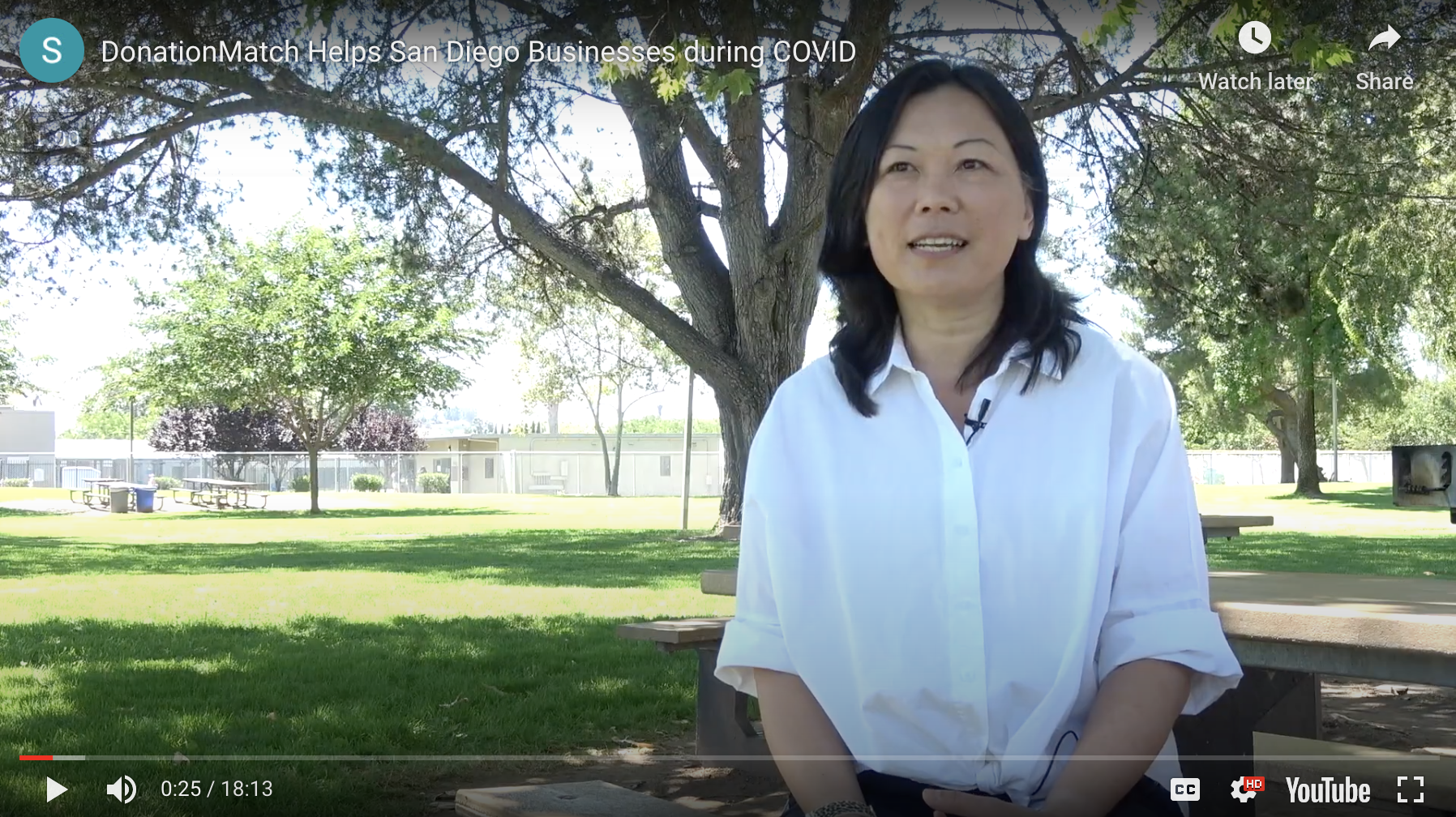
Thank you fo the San Diego Business & Nonprofit Crisis Support Network for aggregating resources for local organizations. Their spotlight video highlighted DonationMatch Co-founder Renee Zau, who is offering pro bono services of up to an hour per organization (business or nonprofit) to assist with in-kind (unpaid) marketing strategy and fundraising event coaching as we adjust and recover from COVID-19. To apply, use the link in the Free Consultants and Coaches section of the San Diego Business & Nonprofit Crisis Support Network website.

4 Bold Predictions for Benefit Galas in a Post-Pandemic World
Guest Post By Alex McDonald, Director of Customer Experience at TravelPledge
If you’re like thousands of nonprofits, the 2020 coronavirus pandemic left you scrambling to cancel, postpone or stream your annual fundraising event.
Now you and your team are probably wondering, “Will event fundraising return to business as usual once we have a vaccine?”
Almost certainly not.
In this post, I make bold predictions for event fundraising in 2021 and beyond.
Prediction #1: “Hybrid Galas” Will Become the Norm
The benefits of virtual galas are undeniable. Nonprofits can engage donors who moved away, feel uncomfortable in crowds, or are unwilling to leave their homes. Moreover, nonprofits save on staff, food and venue.
Unwilling to part with these benefits, nonprofits will incorporate virtual elements into their in-person galas to form a “hybrid gala.”
For example, some supporters will attend the gala in person, while others will stream it online and use mobile bidding software to participate in the silent auction and Fund-a-Need.
As a result, the nonprofit will serve a smaller in-person audience of presumably major donors while involving all who want to participate.
Prediction #2: Live Auctions Will Take a Back Seat to Silent Auctions & Fund-a-Needs
If indeed the hybrid gala gains rapid adoption, it stands to reason that the live auction revenue will shrink as a percentage of total event proceeds. Here’s why:
An organizer of a hybrid gala will have only two options for their live auction:
Make the live auction available to in-person attendees only (and allow pre-bidding by remote attendees).
Utilize mobile bidding software during the live auction.
With Option 1, bidding won’t be as competitive since there will be fewer in-person attendees. With Option 2, organizers risk their in-person audience getting distracted on their phones, which is why many benefit auctioneers insist on bid paddles.
The Fund-a-Need, by contrast, can be executed with bid cards for in-person attendees and mobile bidding software for remote viewers. There’s no bidding, so donations can be committed in any manner at any time.
For the silent auction, mobile bidding software makes it easy for all participants to find items, read descriptions and pay. Additionally, the nonprofits will sell more items since bidding can start days before the gala.
Thus, while the live auction will likely have decreased participation, the Fund-a-Need and silent auction will likely have increased participation and revenue.
Prediction #3: “Elevated” Virtual Experiences Will Be Paramount
The most commonly envisioned form of virtual participation is someone streaming the event on their laptop and bidding on their smartphone.
Creative organizers will seek to elevate the at-home experience to increase engagement. Some examples:
Partner with a restaurant to deliver dinner to remote attendees.
Recruit “living room captains” to host people at their home to stream the event. Captains can distribute paddles and record Fund-a-Need pledges.
Show photos and tweets from remote attendees on the live stream and on the event’s big screen.
The organizers who can best engage the remote audience will enjoy the highest donor attendance, giving and retention. Further, their costs as a percentage of revenue will decrease as they move more of their audience online.
Prediction #4: Some Organizers Will Opt for Smaller, More Frequent Events
Improved fundraising technology, plus organizers and donors becoming comfortable with virtual events, will make virtual events more cost-effective and quicker to plan than ever.
Thus, while many organizers will throw a single big hybrid gala, others will throw multiple smaller events throughout the year to tailor each event to an audience segment.
For example, a nonprofit may throw a small in-person auction, then a virtual streaming event, then a virtual golf tournament (i.e., teams have a two-week period to complete their round). Donors will attend only the events that fit their lifestyle, schedule and interests.
As a result, nonprofits will engage donors in a deeper way, but at the same or lower cost as before. Moreover, event revenue from sponsors will increase because businesses can sponsor the event that best aligns with their target customers.
Alex McDonald is the Director of Customer Experience for TravelPledge, the benefit auction’s connection to generous business owners. Alex manages TravelPledge’s content strategy and customer onboarding. He is passionate about helping nonprofits exceed their auction goals.
The views and opionions expressed are those of the author and do not necessarily reflect the official policy or position of any other agency, organization, employer or company.
6 Expert Sales Strategies Nonprofit Fundraisers Need to Steal
Guest Post By Tatiana Morand, Content & SEO Manager at Wild Apricot by Personify
You might think that your fundraising work is worlds away from that of Fortune 500 sales professionals. You’re cold-calling in hopes of a double-digit gift, while they’re landing six-figure deals over a boozy lunch.
But if you’re dismissing the strategies they’re using, it might be time to take another look.
You both have the same task: convince your prospects that your mission is a good investment.
So, before you pull your hair out trying to think of new “viral” fundraising strategies, take a look at how sales pros successfully pitch their products and consider how this could translate into funding for your organization.
1. Make It Personal.
Research has shown that consumers prefer personalized sales experiences. With so many analytic tools available, individualized recommendations have become the norm. Just think of the way Netflix curates “Recommended For You” selections based on your viewing history.
Mailing out stock donation envelopes doesn’t cut it anymore. Your donors and supporters expect communication that shows you’ve taken the time to get to know them.
That doesn’t mean you have to send handwritten notes for every gift. Instead, identify easy things that you can customize a bit more.
Possible Actions:
Use personalization fields (merge tags) to address donation letters and emails.
Send individualized welcome and thank you emails to new donors.
Handwrite thank you letters at major donors. Affirm their sense of importance by including specifics about the use of their gifts.
Create drip email campaigns to ask donors questions and elicit replies. Drip emails can be triggered by actions or criteria in your database to make them seem like personal inquiries.
Look for commonalities and create targeted segments. Let’s say you work for a literacy organization and realize that 10% of your donors and members are licensed educators. Why not send them unique volunteer opportunities perfect for teachers? Figure out how to leverage their common experience for your organization’s benefit.
2. Go Beyond Your Direct Connections.
A survey by LinkedIn found that consumers are five times more likely to engage with a sales professional if an introduction is made through a shared connection. In your case, this could mean asking your current donors to invite their friends and families to a fundraising event or encourage your current followers to share a post about a new campaign.
Possible Actions:
Start a peer-to-peer fundraising campaign via your current supporters to grow your network.
Look at your executive leadership team’s LinkedIn connections and make a prospect list.
…And then move to your board and do the same!
Create content for your board members to post on their social media feeds. For example, ask them to share a link to a blog post or event announcement.
Familiarize yourself with the community through local chambers of commerce and networking groups. Learn who might want to help your organization.
Introduce yourself to local media outlets. Offer to write articles about the nonprofit sector or mission-related issues.
Pay for your leadership staff and board chair to attend a few key events, such as trainings, conferences, or even other fundraisers. This allows them to network with philanthropists and other nonprofit leaders in the community.
3. Be Confident.
Another essential way sales professionals build trust is through professional competence. They speak with conviction about the products and services they’re offering.
We know that people, unfortunately, perceive nonprofits as dysfunctional or financially unsound.
As a result, you may face an uphill battle when speaking about your organization’s stability and success.
Possible Actions:
Refine a succinct and clear elevator pitch, and professional and consistent branding.
Train your employees and board members to give statistic-backed responses to questions.
Equip your employees and board members with case study examples that prove your organization’s success.
Prepare a 5-10 year strategic plan that can be shared externally. This shows you’re confident that you’re in it for the long haul.
4. Try Out This Tactic.
It seems counterintuitive, but some of the most successful sales pros encourage customers to explore competitors.
While it may feel terrifying or downright foolish to lead potential donors away from your organization, this type of honesty shows you’re so confident that you know they’ll ultimately choose you.
More importantly, it shows that your primary concern is the mission, which will reassure your prospects.
This may mean discussing the other organizations in your area that have similar programs. This openness lets prospects know that you have a mission-first mindset. Potential supporters will appreciate that you care about the greater good, not just the good of your particular organization.
(But hopefully you’ve sold them on why you’re the best option!)
Possible Actions:
Understand others in your nonprofit niche.
Develop your value proposition so you can effectively compare and contrast your organization with others.
Foster and emphasize collaborative partnerships with other nonprofits, so it’s clear you’re willing to share resources if it leads to greater impact.
5. Think Outside the Box.
When it comes to fundraising, it feels safe to play to the audience we already have a relationship with. However, creating new donors is necessary for organizational growth. Businesses are always trying new ways to expand their market share and reach new populations. That means taking risks and allocating resources to new products or novel marketing approaches.
For your nonprofit, this might mean investing in online outreach to engage younger donors or trying a new theme or venue for your annual fundraiser.
Who knows… you might find a huge new base you didn’t know existed!
Possible Actions:
Dedicate a small portion of your budget to experimentation.
Track results in terms of cost-benefit as well as engagement and retention.
Try out a few different fundraising ideas.
6. Less Is More.
One of the most important characteristics of a successful sales pro is tenacity. The same goes for a nonprofit fundraiser.
You’re probably accustomed to being hung up on and just picking up the phone with a smile on your face and trying again and again… and again.
But some sales pros suggest backing off and giving the prospect some space. When it comes to donation calls, less can be more.
So, equip your prospective donors with everything they need to know about your organization within the first couple of touchpoints, including ways to give. After that, the ball is in their court.
This strategy has two benefits: they’ll feel empowered, and you’ll be freed up to pursue other new supporters.
Possible Actions:
Prepare call scripts, sponsorship packages, and presentations that include a clear expectation of follow-up communication and call to action. (i.e. “We will send you an email and follow up in a few days.”)
Donors can also feel empowered by a challenge. A recent study shows that creating fundraising challenges (for example, saying “A generous sponsor has committed to give $1000 if you and your coworkers raise $2000 by the end of the month”) can positively influence giving. These types of fundraisers appeal to humans’ competitive nature and makes donors feel urgent and integral to the operation.
At the end of the day, a top sales executive and a fundraising manager aren’t that different (although the beverage selection may be a little better at one of their offices...).
To get yourself started, think of something you were recently compelled to purchase and consider what made you make that decision. How can you evoke that same feeling or experience for your potential donors?
Start thinking like a sales pro, and it might just pay off.
The views and opinions expressed are those of the author and do not necessarily reflect the official policy or position of any other agency, organization, employer or company.
5 Podcasts for Charity Fundraising Advice

As a nonprofit professional (or professional volunteer), hosting a charity fundraiser is a lot of work. It requires organizing, marketing, event planning, sales, people management, and so much more. As fundraisers, we are always looking for improved methods for making our events more cost-effective and profitable. Here are 5 podcasts to help make the efforts of a nonprofit event planner a little easier, or more effective. These podcasts are in no particular order and range from 30 minutes to over an hour in length per episode. It can be great to fit in these helpful tips during a lunch break, long drive, or even during a daily workout routine.
1. The Classy Podcast
This weekly podcast has stories from leading founders and executives in the social sector who hope to inspire the next generation seeking to drive change.
2. Events with Benefits
Hosted by three longtime event fundraising professionals with 50+ years of combined experience, this podcast seeks to help nonprofits achieve greater success in their fundraising events with less effort. The episodes feature special guests from all different sectors of the nonprofit industry who share their biggest lessons learned, including nonprofit attorneys, directors of events that raise over $1 million or more, benefit auctioneers, and technology companies.
3. CauseTalk Radio: The Cause Marketing Podcast
This weekly podcast, hosted by Joe Waters and Megan Strand, keeps you up to date on the world of cause marketing. The podcast covers trends, tactics and news related to cause marketing and corporate-nonprofit partnerships.
4. Driving Participation Podcast
This podcast talks with marketers, fundraisers and consultants in order to explore what’s been successful for schools, nonprofits, and associations, in order to attract the right people, maintain their excitement, and encourage them to give back.
5. Raise and Engage
This podcast if for nonprofit professionals and covers the latest trends and hot topics. With people speaking from the social good community, it’s designed to help listeners in doing more for their cause.
Questions To Ask When Holding an “In-Store Fundraiser”

In-store fundraisers (a.k.a. on-site fundraisers, restaurant nights, or giveback campaigns) can be a lot of fun and excitement for both hosting venues and the organizations inviting supporters to dine or shop. Before doing one for the first time with a new venue or organization, it's a good idea to get these details clarified in order to set expectations for both sides.
1. What percentage of sales will be donated to the charity?
It is quite common for a store or restaurant to donate around 15%-25% of sales, or a specific dollar amount per package or service sold. However, percentages can vary, and there could be exclusions, such as alcohol, gift cards, or specific product lines. Make sure to confirm the timeline of the event, whether donations will apply to sales all day or only during certain hours, and if there is a minimum number of guests or total sales required for payout.
2. Can the event be held over the weekend?
It is very common for a restaurant to hold giveback fundraisers between Sunday-Thursday, so as to avoid their busiest times during weekends. Stores may have similar policies depending on their sales and other special events as well. Consider exploring other creative options, such as a late brunch or early lunch for a restaurant not normally open in the morning, or even longer-term fundraisers focusing on online or gift card sales for up to a month or more.
3. Will the percentage donated include all sales, or only those from guests referred by the organization?
Be sure to clarify whether the percentage of sales to be donated will be limited to only those who bring in a specific flyer, use a code, or mention the recipient organization, or all sales during the time period. It is also best to find out whether coupons and other promotions can be used during your event and/or affect the amounts you earn.
4. Does the percentage of sales include both food and drink items? Does this include alcoholic drinks as well?
Depending on the restaurant, venues may only donate a percentage of food sold, some include both food and non-alcoholic drink sales, while others will donate a percentage of everything sold. Partnering to create a signature drink or dessert for the event can also drive additional sales-based donations.
5. How will the business help market the event? And what type of promotions can the organization do?
What marketing materials will the restaurant provide to the organization? It’s important to think ahead about how to make promotion easier through social media, flyers, e-mail newsletters, message boards, and online calendars. It is common for a restaurant to provide the charity with a flyer to be used for tracking sales and promotion. However, many businesses will not allow the charity to distribute the flyer immediately outside the venue during the time of the event, such as in the parking lot, so it's necessary to market the event in advance. If the fundraiser is at a store or boutique, find out if shoppers can arrive early and put items on hold to purchase during the event. Ask also if purchases can be made online, which would invite sales from out-of-towners.
7. How can the event be personalized?
One of the best ways to increase event attendance and traffic is to be creative and feature something unique, such as teachers cooking or serving food; an officer, director, or the school band performing; a special discount; or a raffle for a coveted prize or experience, donated by the venue in conjunction with the charity. If there are any limitations based on insurance or capacity, be sure to figure those out ahead of time, too!
6. How will the organization receive the donation?
After all sales are tallied, when and how will the organization be receiving the donation? It’s common for a restaurant to prepare a check for pickup within a few weeks from the date of the event, mail it, or even electronically deposit the funds into the organization's account. Some states have deadlines for how quickly funds must be transferred, so it's always a good idea to refer to your state's Attorney General's office for help.
**********
Great partnerships begin with a clear understanding of what each partner brings and what to expect. We hope these ideas enable you to ask the right questions, clarify details, get creative, drive more sales, and raise more money!
Why Both Charities & Companies Can Benefit From Product Donations

After months of planning for an upcoming charity event, now comes the time where you have to reach out to multiple businesses and ask for product donations or auction items for the event. As a resourceful problem solver, avoid becoming timid or hesitant when you make the request, feeling like you’re asking the business for a handout. Instead, it’s important to realize that a product donation actually does benefit the business!
Having an item showcased at an event is an excellent marketing opportunity for businesses, allowing both you and the company to share in a win-win situation. Understanding that both the nonprofit and the business can win is the key to receiving a successful amount of product donations. Below are some additional tips that can help to prepare as you approach a business asking for product donations or auction items.
Do Research Upfront
Try to first learn what your attendees would prefer to purchase and then find businesses offering those items. This ensures a better fit for both the attendees and the donor. Also, make sure you understand the demographics (age, gender, location, etc.) of the people attending your event. Then when speaking to the businesses, you’ll be able to confirm that the event attendees are their ideal target audience.
Promote Social Good
With the topic of social good on the horizon, many companies are beginning to realize that supporting a cause can provide the business with successful ROI. A study by Cone Communications found that 87% of Americans will purchase a product because a company advocated for an issue they cared about. A business is not only receiving the opportunity to support an important cause, but is also being offered the chance to promote their product or company to hundreds of people at the event, with very little effort needed on their part.
Prepare a List of Benefits
Before speaking to the business, be prepared by compiling a list of benefits you’re able to provide to the organization. For example, the company will benefit by having a room full a attendee at the event that are their ideal target market, while being able to benefit from a low cost method of marketing. They will also benefit by being one product among a limited amount of featured items or businesses at the event. This will help the brand in standing out as a featured product. Don’t forget to offer the opportunity to help promote the brand through social media or provide the company with a social media image or video post-event. Companies would also appreciate receiving links to their site from the event website. Feel free to ask what the company values that you can deliver. It often doesn’t cost more to deliver an additional benefit to the company and it could compel them to increase their donation.
If you can follow these steps when approaching a business regarding product donations, then you should be able to achieve a more successful outcome with a win-win for both your nonprofit and donor businesses.