

Event Activation Strategies for Socially-Responsible Brands
Have you ever looked for exciting nonprofit events for product sampling and brand activation and found one with your ideal target audience, only to discover that a competitor already snagged an exclusive category sponsorship?
Don’t fret, there are usually other ways you can reach the same event’s audience. Repetition breeds familiarity and trust, and there are many low and no-cost ways to help your target customers get to that loyal comfort zone with you.
In-kind product donations, a.k.a. sending products to events for attendees to sample, is a well-known marketing and CSR practice that not only spreads brand awareness but also boosts your brand’s reputation. Founders of brands like Stone Brewing, Hint Water, and Kind Bar have been outspoken about using this strategy to generate growth and loyalty through charity and community events.
Leveraging the power of reciprocity, sampling removes the barriers and financial risk of trying something new for your prospective customers. When your products are at an event that supports a cause they care about, this alignment can enhance their positive feelings about your brand even more.
Let’s explore some event activation strategies so your brand can reach target consumers at highly desirable events without a paid sponsorship.

Why engage in CSR?
Corporate social responsibility, or CSR, is the idea that businesses have an obligation to devote some of their resources towards charitable causes to make the world a better place.
While it initially might not seem productive to “donate,” there are many benefits for you as a donor company as well as the beneficiary in a CSR partnership. Consider the following data from Harvard Business School:
77% of consumers are motivated to patronize socially-minded companies over competitors.
92% of employees working at socially-minded companies said they’d be more likely to recommend their workplace to those looking for a job.
90% of employees working at socially-minded companies say they’re more motivated, hard-working, and loyal.
Not only will you attract prospective customers with your charitable activity, but you’ll make your work environment more satisfying as well. Plus, you may be able to receive a tax deduction for your contributions, which reduces the financial barriers of donating.

What is event activation?
Event activation is a form of brand activation in which your business supplies products or gift certificates to an event for partnership and promotion. In turn, this shares your brand and increases your visibility among new audiences.
This tactic is especially useful as part of a CSR campaign because it allows you to build a charitable reputation while promoting your products and services. So, find nonprofit events that match your values and target market and offer to supply samples for their next event. For example, if you run a pet store, excellent nonprofit partners might be animal shelters or pet clubs and associations.
Unlike TV commercials or social media ads, events are all about socialization and connection, providing you the opportunity to personally connect with potential customers. So be sure to offer ways for attendees to stay in touch, such as signing up to receive special offers on the products they sampled.

Why donate in-kind gifts?
While nonprofits appreciate monetary donations, in-kind contributions can be just as, if not more, valuable to your partner. Some unique traits of in-kind gifts include:
Scalability. In-kind contributions can be more flexible and scalable than monetary gifts, which may need budgetary review. You could donate excess goods, products designated for marketing promotions, time, or experiences based on your resources and bandwidth.
Tax-deductibility. In-kind donations may be tax-deductible, so your business can minimize the financial impact.
More impact for less cost. Your products might be able to help nonprofits offset expenses, but cost you much less than the retail value. In these cases, something that your company may consider excess inventory or a product/service, such as tickets to a museum, that you have ample ability to provide will attribute a much higher value of generosity and support.
Donating in-kind gifts is an especially useful tactic for brands and services with broad target markets as they can support the nonprofit while spreading brand awareness. So, if your brand qualifies, this is an excellent opportunity to kill two birds with one stone!

Top Event Activation Strategies for Product-Based Brands
Why would a nonprofit consider accepting products from multiple companies for an event? Often, an event requires more variety and volume than one brand can provide. If one event is effectively closed to you due to sponsor preference, other events held by the same organization may not be covered by the same exclusivity clauses.
Before determining how you’ll present your products, it’s crucial to ensure you find the right events for your needs. Though the prospect of working a large gala fundraiser is tempting, you need to be realistic and consider your time and budget’s flexibility.
When budgets are tight and you don’t have as much product to give, the trick is finding other highly targeted opportunities like VIP appreciation events or happy hours. While these events are smaller, they’re potentially more personal, impactful, and affordable.
Now, let’s explore some event activation channels you can use to spread your brand awareness.
Gift Bags
Sponsor exclusivity may not extend to products included in gift bags. When providing products for an event’s gift bags, consider:
Pros: Everyone at the event gets your product.
Cons: You won’t directly interact with consumers, increasing the need for bouncebacks.
Gift bags are a smart option if you have products to send but are short on time or staff. This low-touch opportunity can establish some brand recognition without pulling too much from your human resources.
Vendor Booth
Regardless of what competitors are doing, you may still be able to purchase a vendor booth where you can interact with attendees and give away samples. Reach out to see if buying a booth is a viable option for your team. Consider:
Pros: People get to interact with your team, try your product, and give direct feedback.
Cons: You’ll have to consider the cost of the booth itself and staff time, especially if events last multiple days.
Vendor booths are the best option if you have the time, staff, and budget to make it happen.
Incentives
Fundraising campaigns and a-thons may use packages created with your products to reward participants who reach certain levels. When offering your products to be used as incentives, consider:
Pros: You receive extra promotion of your items as a coveted prize, lending your brand prestige. Links to your website and social media may be used/promoted as well.
Cons: Typically no direct interaction with attendees.
Try this strategy if you can offer universally-desirable, unique packages and want to save time.
Silent Auction or Raffle
If an event has a silent auction or raffle, this may be the easiest way to get brand exposure. Donating a larger basket or bundle, exceeding any competitor’s package if you can, can draw as much attention as a sponsor’s name on a program. Here’s what to expect from this strategy:
Pros: This is a very common need of nonprofits and schools that fundraise, so can be easily scalable to promote your brand and products and engage as many people at events as you want it's relatively easy to put together a package, such as a bundle of brand favorites or a gift certificate for a popular starter service.
Cons: There’s no direct interaction with attendees unless you attend the event yourself.
This strategy is best for brands looking for a quick, easy way to get in front of attendees, including new product launches One of the most successful companies to utilize this tactic, becoming the foremost brand in their industry, was Green Mountain Coffee Roasters, which established a national reputation for generosity and was able to introduce their Keurig machines, pods, and convenience into tens of thousands of households through donating to silent auctions alone.
Day-of Volunteering
If the event is in your community, consider gathering a team to volunteer together. Wear branded attire and talk up your own contributions such as gift bag items or auction or raffle prizes, when meeting attendees. Volunteering considerations include:
Pros: This strategy is scalable to involve as many or as few of your employees as you want. It also gives you an experience from an attendee’s perspective, so you can evaluate how much to sponsor or participate in future events. Plus, it involves your employees directly, offering them a sense of purpose.
Cons: This requires your employees and friends to participate, so it’s up to you to encourage them to volunteer.
This approach is best for causes that are universally liked by your employees. Creating fundraising teams for races and runs can also provide similar exposure.
Committee Volunteering
Allowing your team to join event planning committees as company-paid volunteering can give you the inside scoop on opportunities you may not otherwise hear about, as well as form relationships that can benefit your brand in the future.
Pros: You’ll gain access to insider information and opportunities. Plus, you could get first rights of refusal for the promotion of your products.
Cons: It’s a more involved time commitment, depending on the event size, history, and your selected role.
Consider committee volunteering if you have highly dedicated team members willing to represent your company by taking on more involved roles in community partnerships.

Getting Started
Whether you’re new to partnering with nonprofits or looking for new collaborators, it can be daunting to find the perfect match for your business. But, with the help of event databases and platforms, it’s never been easier to connect with the right organizations.
A corporate giving platform like DonationMatch enables you to set parameters for finding events by size, location, audience demographics, and event type to identify and directly reach out to event organizers. In turn, you’ll save significant time, effort, and money.
To start your event activation strategy strong, use DonationMatch to find collaborators that align with your values and goals. Then, plan which event activation tactics work best for you, and start spreading the word about your brand. If you consistently apply these strategies to build and strengthen relationships with consumers through nonprofit partners, your brand will flourish along with your social impact.

Key Takeaways from DonationMatch's Educational Panel with NXUnite
Elevate your nonprofit fundraising efforts with innovative strategies from NXUnite panelists.
Continuous advances in fundraising strategies allow nonprofit professionals to more easily connect with donors to gain support for their missions. DonationMatch CEO and co-founder Renee Zau was joined by Julia Beltran of Double the Donation, Brian Lacy of NPOInfo, and Sarah TeDesco of DonorSearch for NXUnite’s “Upping Your Fundraising Game: New Tactics to Add to Your Roster” to discuss innovative fundraising practices for the current nonprofit landscape.
Speakers shared insights and actionable fundraising tactics from their experiences working in the mission-driven sphere.
Topics the panelists discussed were:
Importance of new approaches
The panelists began by discussing the value of implementing new approaches to fundraising. DonationMatch’s Renee Zau observed that novel tactics are especially necessary because of COVID; nonprofits must manage their virtual presence more diligently to be more easily found.
Renee advocated for evaluating your website and tools each year. As new technologies and strategies emerge, updating your digital strategy will allow you to reach people most effectively and lessen your workload. As Renee noted, digital outreach is often the easiest way for you to contact donors, as well as the most convenient way for donors to receive information.
One method Renee suggested for finding new tactics was to attend other organizations’ events. Participating in other nonprofits’ fundraising can often help you discover ideas for ways to improve your own practices.
Evaluating areas for improvement
Asking your audience what methods resonate with them will allow you to be consistent with popular tactics and stay updated on areas for growth. Double the Donation’s Julia Beltran emphasized the value of data-driven changes. Assessing your fundraising process before making changes will allow you to focus your efforts on areas that require the most attention.
Julia suggested starting your evaluation by looking at your tech stack. This is an opportunity to assess what you can automate and measure using your existing technology. Fundraising metrics from your software platforms can help you evaluate which strategies are most effective and what you can change.
You can use information already available to you before kicking off a new initiative. For example, Julia noted that most email marketing platforms provide open and click rate statistics. You don’t need additional email software to collect this information, and you can use the data to inform a marketing campaign.
Making an impact with limited resources
Limited access to resources may serve as a barrier to overhauling fundraising tactics. For organizations facing this obstacle, Renee advocated for leveraging corporate partnerships, whose benefits could include a broader audience for educating others about your mission, funding, potential new individual donors, marketing support, volunteering as teambuilidng, collection drives, and donated products and services of the company.
Many businesses have a variety of resources and reasons of their own for wanting to partner with you. Ensure that all the ways to participate in and support your organization are clearly shown on your website.
To find corporate partners, Renee suggested that nonprofits look at other organizations in similar fields and see which companies they partner with. However, be aware that corporations may be exclusive in their support.
When this is the case, nonprofits can assess the demographics of their own supporters and build a case for partnering with you, too. With data about who you can help partners reach, nonprofits can appeal to marketing departments by demonstrating that engaging with you would give the company access to a target audience through a win-win partnership..
Conclusion
Adopting new strategies allows nonprofits to maximize the return on their fundraising efforts. In response to challenges like COVID and financial constraints, organizations can implement innovative fundraising strategies to continue to effectively raise money and advance your mission.

The Customer Journey: What It Is and Why It Matters
While it’s obvious that attracting and retaining customers is essential to a business’s success, many organizations actually lack a framework for analyzing key interactions they have with their customers. Interactions ranging from initial conversations with a member of your sales team to troubleshooting technical issues can determine whether a customer continues to support your business over the long run.
All of these interactions make up the customer journey, and understanding these steps is key to their continued satisfaction and your business’s continued success. Businesses with a strong strategy for analyzing and improving their customers’ journeys can provide their customers, employees, and other stakeholders with an overall better experience.
To help your business better understand the customer journey, this guide will explore three questions that can help you improve your own customer journey strategy:
What is the customer journey?
Why does the customer journey matter?
How can my business improve the customer journey?
While this may be a new way of looking at customers’ experiences with your business, remember that the principles behind it are ones that your business likely already values. Approach customers with empathy, aim to create frictionless experiences, and constantly strive to improve how customers interact with your business.
What is the customer journey?
The customer journey consists of all of the interactions customers have with your business in the entire course of your relationship. This includes their initial discovery of your business by interacting with marketing materials, their first sales process and purchase, their use of your product or service, the support and communication they receive from your business, and the efforts your business makes to retain them as a customer over time.
On the surface, the customer journey looks like a simple series of interactions. However, businesses interested in developing a holistic customer journey strategy need a more nuanced understanding of the other concepts and elements that inform a journey, including:
Customer experience. Customer experience (CX) is somewhat synonymous with the term customer journey, but it also refers to the broader framework and programs that businesses develop to improve their customer interactions. Specifically, a CX program is a dedicated effort a business makes to collect feedback from customers after key touchpoints in their journey to learn how these pivotal moments can be improved. Your journey mapping and strategy fall under the broader umbrella of CX management.
Moments of truth. A moment of truth, or pain point, is a high-stakes touchpoint in the customer journey that can often determine whether a customer sticks with a business or not. For example, a customer contacting a software provider’s support line for assistance to solve an urgent problem with the product would be considered a moment of truth. In this scenario, the customer is likely frustrated and a poor interaction may lead to them seeking an alternative service. By identifying moments of truth in your customer journey, your business can actively implement improvements to minimize negative emotions, show empathy to the customer’s struggles, and provide a solution.
Voice of the customer. Voice of the customer (VoC) refers to your customers’ perspectives on your business. This includes their expectations, likes, dislikes, and any other feedback they have provided. By surveying your customers, you can better understand their unique voice and how changes in your business impact them. A VoC or feedback collection program should be an integral part of your broader CX efforts.
How exactly these concepts and programs should be approached will depend on how your customer journey and communication channels are constructed. For example, a business that uses automated communication for the majority of the process will have different moments of truth to consider than one that focuses more heavily on building one-on-one relationships with individual clients.
Why does the customer journey matter?
Customers find and stick with your business for many reasons. They might first find you through your standout marketing strategies or stellar reputation in the space. They might stick around because they appreciate your brand’s philanthropic efforts and identity or feel that your product is superior to your competitors. Among these reasons, customers will heavily weigh the service they experienced and the process of making a purchase at your business.
Your customer journeys matter because all of the individual interactions and factors at play contribute to your ultimate likelihood of retaining their long-term business, which should be a primary goal for any organization.
In other words, the customer journey your business offers will directly and indirectly impact how customers view your business and if they will buy from you again. There are other benefits to improving your customer journey as well, such as:
Improved customer loyalty. Customers who feel that your business created a positive experience for them, showed empathy for their struggles, and implemented their feedback will likely feel increased brand loyalty. This means they will likely be retained not just as long-term customers but as active promoters of your brand.
Faster response time. Part of building a customer journey strategy involves creating a process for responding to negative feedback. For example, during a moment of truth that goes poorly, a customer might fill out a survey that reflects their negative experience. With an effective program in place, your business will be able to reach out to the customer quickly to resolve their issues, potentially saving your relationship with them.
Better data collection. Deliberately monitoring your customer journey will allow you to collect more data on your customers, their needs, and preferences. This information can be used for marketing purposes or planning new activities and products they might like.
CX and the customer journey are continuous processes, and regularly reassessing what goes into them at your business will allow you to keep up with changes in customer preferences. Make sure to routinely collect feedback during pivotal touchpoints to check if your improvements have succeeded, as well as how customer needs naturally shift over time.
How can my business improve the customer journey?
The customer journey can be improved through deliberate tracking, analysis, and implementation. Just like many other internal processes at your business, such as communication, budgeting, and project management, there are software solutions that can help you monitor and generate reports on your customers’ journeys.
Explore CX software solutions that have customizable survey tools, allowing you to tailor them to ask pertinent questions about your customers’ experiences during critical moments in their journeys. Before designing these surveys, consider your customer journey map.
The customer journey map is a visual representation of how your customers or customer segments interact with various parts of your business during their journeys. It considers a business's different audiences, each touchpoint, and can help explain why certain outcomes happened.
PeopleMetrics’ guide to customer journey maps walks through the six core components of creating a map for your business:
Determine your objectives. Establish a specific goal for your map to help focus your efforts. This will be related to the overall scope of your customer journey map. For instance, does your map cover the entire customer journey or hone in on a specific moment of truth?
Define your personas. Take a look at your customer data to create personas. These personas represent various groups of customers with shared characteristics, such as their product or service tier, motivations, common pain points, and goals.
Break the journey down. Work with your team to break down the customer journey into distinct steps. Consider the voice of the customer during this step by dividing the customer journey based on what actions the customer is taking, rather than what may be happening internally at your business.
List all touchpoints. Working through the steps you just identified in the customer journey, list all of the touchpoints customers have with your business in each stage. Consider both actions the customer takes and processes that happen internally that may impact the customer’s experience along the way.
Compile touchpoints. Identify which touchpoints are relevant to the customer journey in question and organize them based on your map’s overarching purpose. Pay special attention to potential moments of truth and other critical touchpoints—referencing past customer feedback can help you identify these.
Test your customer journey. Present your map to your team for feedback. Discuss touchpoints they would consider as moments of truth, and make adjustments based on their feedback. Study your customer interactions going forward to see if they follow the course you’ve outlined, collect more information, and make tweaks over time.
If you have difficulty organizing your customer journey map, remember that these journeys are a continuous, non-linear cycle. Try zooming in on specific points of the customer journey to make better sense of moments of truth, rather than analyzing your customer journeys as a potentially overwhelming whole. Doing so can help you identify outcomes related to individual interactions, which can easily get lost when looking at the entire customer journey at once.
Your business should strive to make your customers’ experiences with your business as frictionless and positive as possible. By analyzing your customer journey and taking steps to improve it, you can retain more customers, build brand loyalty, and stay up to date with changing preferences. Improve your customer journey by mapping it out, creating surveys, and investing in new tools to support your organized, intentional approach.
About the Author:
This is a guest post contributed by Sean McDade.
Sean McDade has been helping companies optimize customer experiences for over twenty years. An angel investor in the Philadelphia region, he is also the founder, CEO, and visionary of PeopleMetrics, a leading provider of experience management software and advisory services. In addition to working with a number of leading pharmaceutical and biotechnology companies, he is the author of two books.

A Crash Course in Effective Community Engagement Strategies
The word “capital” is commonly used in business contexts. This term might conjure images of bank statements or investors. However, there’s another type of capital that’s equally important for the long-term success of an organization: social capital.
Simply put, social capital consists of the strength of the networks, connections, reputation, and relationships that organizations build with community members. It’s the foundation for relationships that an organization has that allow it to flourish and achieve its goals.
This is where community engagement strategies come in. Community engagement is what helps an organization build new relationships, strengthen existing bonds, and ultimately generate more social capital. Whether you’re a business trying to increase sales or a nonprofit looking for volunteers, visible community engagement is critically important.
Thankfully, you don’t need to be a large company or have a communications or PR expert to get started engaging your community— simple steps (like the ones we’ll discuss here) can make a big difference to your success.
Here’s what we’ll be covering in our crash course in community engagement strategies:
Let’s explore how you can boost your outreach efforts to grow your network and social capital and make a bigger impact in your community and your organization.


Community Engagement FAQ
Before we dive into our community outreach best practices, let’s answer some fundamental questions about community engagement.
What are the principles of community engagement?
Community engagement is the strategic process of connecting with others in the community or with shared missions and interests, typically to achieve a specific goal. It’s one of the foundational elements of social capital that your organization can use to expand connections and involve your stakeholders.
Community engagement has different applications based on your organization. Businesses often seek to make new connections with the goal of increasing their visibility and acquiring customers, while a nonprofit seeks engagement to raise donations and drive impact. Instead of being a one-time public-facing event or campaign, ongoing programs or initiatives aimed at engaging target markets are usually more successful overall. That’s why it’s essential that an organization has a strong grasp on its goals and resources before jumping into outreach activities.
Why is community engagement important?
Building social capital opens doors for you to reach untapped audiences and broaden your organization’s offerings. Without ample ability to leverage social capital, an organization risks relying on a static support base or having to spend more money on paid advertising and marketing. Social capital and the trust you build with it open doors for longer-term success, such as higher customer or donor satisfaction rates, partnerships with other nonprofits and businesses, and opportunities to expand into new markets.
What do I need to do beforehand?
Before embarking on any community-building activities, your nonprofit or business needs to create a plan for your outreach campaigns. You’ll want to decide the following:
Your #1 desired outcome. Keep your goals at the forefront of your mind when planning your community engagement strategies. This will help you stay focused on the parts of your campaign that really matter.
Your organization’s focus area. It’s always a smart idea for your nonprofit or business to get involved with programs or events that relate to your niche, as you’ll be able to draw in supporters who are interested in your core offerings, too.
Your desired audience. Be as specific as possible when deciding who you plan to target; just saying “as many people as possible” is too vague. Really hone in on characteristics such as hobbies, lifestyle, interests, favorite brands or influencers, and possibly ages and geographic locations of the people you want to engage and what will attract their attention.
What worked in the past. If you have a popular initiative that’s worked in the past, you should bring its winning elements into your new plan. Perhaps you can work with your team to update it or see how you can make it even better.
Current trends or events. Consider throwing an event or promotion based on the time of year or season, such as a holiday celebration or something special to your industry.
Your bandwidth and resources. Your organization might be a small nonprofit or business with finite resources, and that’s okay. Be sure to take your capabilities into account when planning your outreach.
Your desired campaign timeline. Draft a rough timeline so you can periodically evaluate your progress and adjust, if necessary.
The scale of the change. Your approach will vary if you’re planning a one-time event versus a long-term operational shift. Be sure to grasp the scope of your changes and who they will involve, internally and externally, so you know how to prepare.
There isn’t one catch-all approach to developing your community engagement strategies. Your organization needs to take care to look introspectively during the process so your solution will be properly tailored to your needs and target audience.

General Community-Building Tips
It’s true that nonprofits and businesses have different classifications under the IRS, but beyond that, they actually have many similarities. Both types of organizations are focused on raising money to achieve their goals and need ample social capital to expand and thrive.
That being said, let’s explore some ways that organizations in either sector can get the public involved in their activities.

Find a community engagement partner in the other sector.
Nonprofits and businesses have a lot to gain from working with each other. On the business side, starting a corporate philanthropy program offers significant benefits, such as:
Positive publicity. 77% of consumers are motivated to support businesses that actively try to make the world a better place. Associating your business with a beloved community nonprofit is a great way to appeal to this crowd.
Greater loyalty from customers. If your business has and promotes its partnership with beloved causes, its donors are more likely to shop with you instead of a competitor.
Employee engagement. One of the best benefits you can offer your team is the chance to participate in corporate philanthropy. Work together to make a difference both in the world and in your workplace by offering opportunities such as matching their charitable gifts.
A tax write-off. Your business might be able to cut down your taxes while helping out causes you believe in with the IRS’s charitable deduction program.
As for nonprofits, teaming up with a business offers advantages such as increased financial stability, access to valuable in-kind donations of products and services, money to fund projects, and exposure to the business' employees and customers.
If you’re in either sector and want to find a partner but are unsure where to look, corporate giving platforms like DonationMatch can help you get paired with corporate philanthropy partners that align with your goals, focus area, and bandwidth. It takes the guesswork out of setting up a corporate social responsibility (CSR) program and is an effortless way to build valuable social capital. Plus, DonationMatch is free to get started, so it's an accessible solution for both nonprofits and businesses.
2. Prioritize customer service and relations.
Growing your connections is a crucial, yet uncertain process. You can't just focus on attracting new customers and partners - you have to actively work to keep them engaged, which is an ongoing process. This is why having a seamless customer service approach is so vital for the success of your organization.
While you can’t control what everyone thinks about your work or products or services, you can control many parts of their experience with your organization. Positive word-of-mouth in your community is among the best advertising you can get, and it’s free. Here are some easy ways to strengthen your customer relations:
Make it easy for people to reach you. Whether it’s updating your Google My Business profile with your current contact information, adding a chatbot on your website, or responding to social media direct messages, staying on top of communications with the public should be a top priority.
Take feedback from your audience. Sometimes, it’s difficult to see your organization’s blind spots from the inside. Conduct satisfaction surveys periodically so you know how to improve your offerings to match your audience’s intent and goals. Let your audience know that you value their input so you can better serve them.
Choose a customer-minded team. While recruiting new team members, ensure that you gauge their attitude toward customer service. During the interview process, ask your interviewees how they would handle certain situations with customers, teammates, and management. They should value skills and traits such as active listening, friendliness, optimism, and best-in-class responsiveness.
You can have the best events and CSR campaigns around, but you’re unlikely to maintain long-term community engagement without great customer service as well. Encouraging a positive environment in your nonprofit or business is crucial for building connections across your community.
3. Invest in the right community-building tools.
Technology has never been more accessible and useful for nonprofits and businesses trying to reach out to the public. There are numerous platforms your organization can use to manage and grow its network of connections. Here are some tips on technology that will aid your community engagement:
Social media. In 2021, 72% of American adults used social media to connect with others. To tap into this large audience, social media accounts can be used to engage your community more often and informally. Many platforms even offer business profiles with special features. Before you sign up, do research to determine which platforms your target audience uses and what kind of content they prefer so you can effectively draw their attention.
Customer relationship management system (CRM). A CRM is a software solution that functions as a database for nonprofits and businesses. Depending on the platform, you can manage all relevant customer communication data, such as contact information, sales/donation analytics, and marketing automation. This software is essential to streamline your outreach efforts and track the touchpoints in your relationships.
Automated communication systems. Besides social media, your nonprofit or business can use other digital communication platforms, such as text-to-give and email listservs.
These are just a few of the technology solutions available that can streamline and support your community engagement efforts. Consider working with a technology consultant to help you identify ways that technology can support your community-building goals and fill in those gaps with new solutions.
4. Use distinct branding.
The largest corporations and nonprofits in the world all have one thing in common: they’re recognizable by their branding. In order to be memorable and recognizable, your organization should make sure that your brand identity reflects your values and focus area and stands out.
If you need help making or updating your logo, there are numerous tools that both businesses and nonprofits can use. Nonprofits can even get discounted services and licenses from some providers with proof that they’re registered as a 501(c)(3).
Don’t forget that your branding should be versatile enough to put it on all of your external deliverables and communications. Consider working with a professional graphic designer for extra help.

Community Engagement Strategies for Nonprofits
Chances are, community members will want to engage with your organization, but might not know about you or how to help. It’s up to you to eliminate the barriers.

1. Engage your entire community with fundraising.
The best way to entice more prospects to give is by inviting new community members to your events. While profitable, a nonprofit only holding high-end events such as annual galas will appeal to only a narrow group of donors. In addition to member- or donor-only events, which are important to reward those already supporting you, consider throwing an open-invite event that can include everyone else. Here are some events that could draw a crowd:
Funfair/carnival. This is a great opportunity for businesses and nonprofits to team up to throw an all-ages event. Sponsorships, in-kind donations of a venue, food, games, and prizes, and helping to source volunteers are very common partnerships.
Give-back fundraising nights/days. Many retail businesses and restaurants are open to this mutually-beneficial opportunity to donate a portion of the sales during a specific time to a designated nonprofit. Be sure to look up and follow any applicable state regulations regarding such “commercial co-ventures” when marketing these.
Peer-to-peer fundraisers. Put the power of fundraising in the public’s hands. Launch a peer-to-peer fundraising campaign that benefits one of your core initiatives with a fun activity, such as a dance-a-thon or park clean-up. Then, advertise it to the community as an opportunity to support their neighborhood. Leveraging the networks within your area will help news of your event to spread rapidly and get people interested in your brand, event, and cause.
Community-wide fundraisers provide the chance to get to know local supporters on a personal level and show them the work that your nonprofit does. Your connections are one of your most valuable resources, so make them count!
2. Work with influencers to boost your visibility.
You can leverage the connectivity of social media by syncing with influencers in your industry. If you have any colleagues or connections with considerable followings in the nonprofit social media space, invite them to speak on one of your webinars, write a guest post for your blog, or participate in an interview for your podcast. When they market this appearance to their many followers, you’ll get an influx of visibility for your cause, as well as status for being affiliated with a thought leader.
3. Make it easy to donate.
No matter what fundraiser you choose to put on, a seamless and accessible donation process is imperative. If the process is convoluted and the barriers to participation are too high, potential donors will get discouraged and give up. Here are some ways you can make your fundraisers go as smoothly as possible:
Accept multiple types of donations. To activate more giving across the board, accept multiple types of gifts beyond financial donations, such as in-kind donations of products and services like food, supplies, and items that can serve as prizes or incentives. Additionally, time is a valuable gift. Set up a volunteer program so your supporters can help you operate your programs in their free time.
Use a mobile-friendly donation page. In the digital age, donors want the giving process to be straightforward and quick. Offering an online, mobile-friendly donation page provides donors the ease of donating without turning off their phones. Plus, modern options are simple to integrate into your website and CRM, ensuring all data is effortlessly and automatically reported.
These adjustments are simple, cost-effective, and user-friendly. Always listen to your donors’ feedback to continue streamlining the giving process for continued growth.
4. Apply for the Google Ad Grant.
A pain point for many nonprofits is the paradoxical issue of needing to spend money in order to effectively fundraise. To maximize your returns on investments, your nonprofit should focus on cost-effective yet highly visible marketing opportunities. Google offers nonprofits a way to save on advertising in the form of the Google Ad Grant.
This program awards certain types of accredited 501(c)(3) organizations the opportunity to appear on the top of the search engine results page for keywords of their choosing related to their work. This type of advertising can easily cost thousands of dollars monthly, but through this program, nonprofits can get up to $10,000 of advertising per month for free.

Community Engagement Strategies for Businesses
While businesses aren’t bound to public service like nonprofits are, they can realize growth by engaging in charitable activity and forging relationships throughout their community. If you’re a business owner and could use more ideas for public outreach, here are some easy tips.

1. Undertake a CSR initiative.
Corporate social responsibility (CSR) is the idea that businesses have an obligation to improve the quality of life in their communities. For-profit companies can participate by starting their own CSR initiatives. Your business might choose to make several smaller gifts to many different nonprofits or enter an in-depth collaboration with one nonprofit as a sponsor.
Here are some essential steps to starting a CSR initiative:
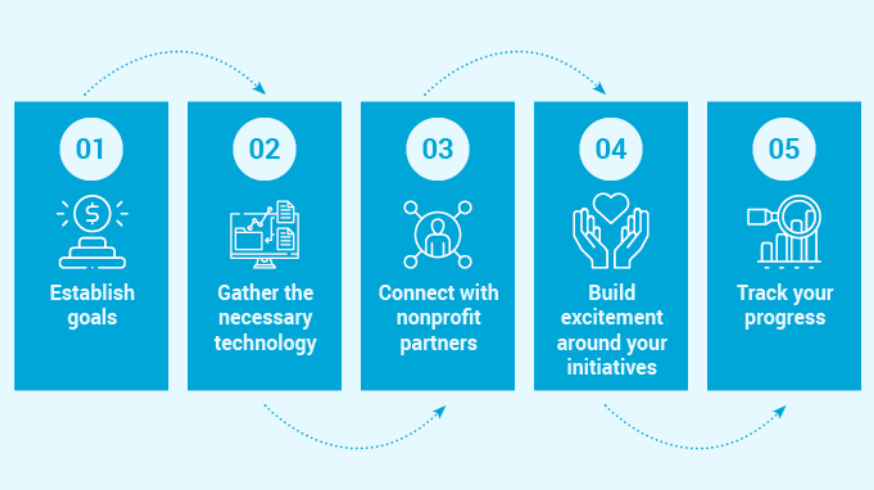
Establish your goals.
Gather the necessary technology.
Connect with nonprofit partners.
Build excitement around your initiatives.
Track and report on your progress.
However you want to structure your corporate philanthropy efforts, you should always strive to find nonprofit partners that best fit your needs. To learn more about these steps and other CSR programming options, check out DonationMatch’s complete guide to corporate philanthropy.
2. Team up with other Community-oriented businesses.
To get new customers in the door, it’s helpful to tap into markets that you haven’t encountered yet.
A mutually beneficial way to reach new audiences is to team up with complementary companies in your area. For instance, a sporting goods store might choose to collaborate with a local restaurant for a basketball tournament in which teams register to compete using the store’s equipment and the restaurant caters for the championship match.
To find a local business that would be a good fit, first consider any contacts you currently have at local businesses. You could also ask for referrals to other businesses in your community that will fit in well with the event you’re planning. Finally, work with your partners to put together an event that’s mutually beneficial and perhaps even profitable. You’ll hopefully both be able to increase your visibility to each others’ customer bases and the public.
3. Leverage a loyalty program.
Constantly acquiring new customers is time- and resource-consuming. In fact, selling to a returning customer has a 60-70% success rate while converting to a brand new prospect has merely a 5-20% success rate. To minimize these impacts and build more reliable revenue streams, bolstering customer loyalty is imperative.
Incentivize your customers with loyalty programs, such as a rewards card or special membership perks, to encourage your customers to keep patronizing your business over your competitors. Thankfully, apps now exist that can integrate with e-commerce and POS systems and track purchases by phone number or email address so less paperwork is involved.
To launch a loyalty program, you’ll first want to establish goals so that you can keep them central to your plans–are they more frequent visits, higher total purchases, or maybe more referrals? Next, determine how your customers will generate points to receive rewards—classic models include earning points per dollar spent or using a punch card to track each visit.
Next, consider how you’ll promote the program. You can advertise your loyalty program by asking each customer if they’d like to join and including it in your marketing materials posted at your registers and on social media. Finally, ensure that you’re keeping records on how many customers register for the program and how your total sales change after implementing the loyalty card. Use a CRM that can register and report on your loyalty program and how it’s impacting your business.
Wrapping Up
Undertaking new community engagement strategies can be a daunting task, especially without extensive existing connections within your local area. And with everyone being so busy, it’s hard to keep track of possible partners and their current focuses.
To bridge the gap between you, your community, and new audiences of supporters and partners, many companies use DonationMatch's donation management platform. Our solution helps companies and nonprofits find potential partners and event opportunities for donated products and services to be showcased. We customize your search so donations are only shown to organizations that meet their criteria, reducing the work for everyone. And it’s free for nonprofits and businesses to sign up. Eliminate the guesswork, save precious time, and become a name your community will never forget with DonationMatch.

Additional Resources
In-Kind Donations: Everything Your Organization Should Know. Take a deeper look at in-kind donations and how to include them in your fundraising strategy.
Corporate Philanthropy: What Your Business Needs to Know. Corporate philanthropy has transformed the nonprofit world and has the potential to transform your business too. Learn more about the world of corporate philanthropy in this guide.
Corporate Giving Program: Give Smarter with DonationMatch. Considering uniting with a company or nonprofit and want some guidance? Explore how DonationMatch’s corporate giving platform can help your organization today.
In-Kind Donations and Tax Deductions 101. While in-kind donations are an essential part of giving, quantifying just how much their tax deduction is can be puzzling. Learn the ins and outs of in-kind donations and tax exemptions with DonationMatch’s tips and tricks.

4 Signs That Your Nonprofit Needs a Custom Website
Your nonprofit needs a website, but you may be torn between a template-based design and a custom site. Here are four signs that a custom site is right for you.
You can think of your website as your nonprofit’s online headquarters. This is where you provide information about your mission, offer updates about campaigns and events, and house important tools like donation forms.
Because your website is the hub of your nonprofit’s online presence, it’s worth taking the time to get the design of your site just right, whether you’re building a website for the first time or revamping your current one.
But these days, especially with the increasing ubiquity of user-friendly nonprofit website building tools, it may be difficult to know whether a template-based design or a custom job is right for your organization.
Here’s the thing about custom nonprofit websites that give them an edge over DIY-type, template-based designs: A custom nonprofit website is like a fingerprint—it’s unique to your nonprofit and your nonprofit alone. And on top of having a unique look and feel, a custom website is built with the features and tools that meet your specific organization’s needs.
To help you decide which path your nonprofit should take, let’s take a deeper dive and explore four signs that your nonprofit needs a custom website:
Even if your nonprofit isn’t quite to the point where you need a custom website, knowing these four signs can help you be proactive in how you manage your current site and make it the best it can be. Plus, you’ll be able to recognize your nonprofit’s needs and kickstart the custom design process when the time comes. Let’s jump right in!
1. Supporters are struggling to find you online.
Say a potential supporter meets one of your staff members at the grocery store. They strike up a conversation, and the potential supporter expresses an interest in donating to your organization. The staff member excitedly encourages the potential supporter to go to your website to complete their gift.
Back at home, the potential supporter Googles your nonprofit, but your website is nowhere to be found! Consequently, your nonprofit loses the donation this potential supporter wanted to give.
The last thing you want for your cause and your beneficiaries is to be MIA on the internet. But you have to be proactive in helping your audience find you, just like sending out invitations when you plan a party.
So, how can you let people know your nonprofit is online? Here are three suggestions:
Employ SEO best practices. Search engine optimization (SEO) is the process of optimizing your website content so that it’s more visible to search engines like Google. According to Cornershop Creative’s guide to SEO for nonprofits, doing things like targeting specific keywords in your website’s written content or securing backlinks to your website from other authoritative sites can signal to Google that your website should be ranked higher up on its results pages, thus increasing visibility.
Apply for the Google Ad Grant. The Google Ad Grant is a little different from a traditional grant. It’s simply a grant that provides eligible nonprofits with $10,000 of monthly Google Ads—the paid search results that show up at the top of the Google results page when a relevant query is Googled. It’s an easy way to get attention for your nonprofit! Check your eligibility to start the application process.
Direct people to your site from your social media profiles. You can also let your supporters know that your website is alive and well by leveraging your social media presence. After all, the average internet user spends about two and half hours a day on social media. So, by linking to your website content in your social media posts and including a link to your website in your profile, you can nudge your followers to check out your website and all it has to offer.
An experienced web design professional can help your supporters find your nonprofit online. For example, as they design your custom site, they can set you up with the framework for an SEO-friendly website and coach you through optimizing future content for the web. Some web designers can even provide consulting on opportunities like the Google Ad Grant!
2. The user experience on your current site could be better.
When a visitor lands on your website, what is their experience like? Do they find your site useful and intuitive to use? Does an impressive design draw their attention to your important tools and resources?
Taking a look at your website from your visitors’ perspective might show you that there’s some room for improvement when it comes to how your website looks and functions from the front-end.
Here are a few potential user experience problem areas a web design agency can help you with:
Load speed: To improve conversions on your website, your pages should be loading in 1-4 seconds, according to Portent. In other words, the longer it takes for your web page to load, the less likely it is that your website visitors will do something other than get frustrated and exit your site. To improve your website’s load speed, compress all of your visual files and minimize redirect chains.
Accessibility: Your site should be accessible to users of all abilities. If it’s not, you’re shutting out part of your community of supporters who could make a big difference in your organization’s ability to move its mission forward! You may even be coming up short in meeting website accessibility requirements for your country or state. Maximizing accessibility can begin by ensuring that your content is easy to read and understand and all multimedia content has alt text or captions.
Mobile-responsiveness: Have you ever done the “pinch-and-zoom” when looking at a website on your mobile device? It can be incredibly frustrating to try to read content that isn’t mobile-optimized. To make sure your website can be viewed on all devices, minimize the use of pop-ups, check that the typography you’re using is legible on mobile, and size buttons, links, and menus so they’re able to be tapped.
When you invest in a custom-built website, you can better anticipate your website visitors’ needs before they arise. A skilled designer can help you identify potential problem areas and make proactive changes. For example, if your volunteer registration form is difficult to find, you might build specific call-to-action (CTA) buttons into your homepage so that visitors can more easily access that resource.
3. You want your site to stand out from the crowd.
When you explore your options for a DIY, template-based website, do you ever feel like you have limited choices for how your website will look? Maybe you’ve tried to set up your website by yourself on WordPress, for example, and you kept running into templates that you’ve seen a dozen times before.
It’s no wonder that picking through a list of templates can be a little off-putting. By settling for an oft-used website template, you’re doing your nonprofit a disservice because you’ve likely spent countless hours engineering your nonprofit’s branding strategy.
Everything from your logo to your tagline and chosen color scheme are unique to your organization and its mission. So, trying to shoehorn your branding into a pre-built website template may feel like trying to put a square peg in a round hole.
The beauty of a custom-designed website is that your final product will truly be tailored to your organization, strengthening your organization’s branding and boosting recognition from supporters. You won’t have to settle for a certain font or navigation menu configuration just because “that’s the way the template is.” Instead, you can get exactly what you want.
This is not only great for standing out on the web, but also for providing a cohesive, streamlined experience for your community of supporters. For example, when someone sees the decor at your organization’s gala and then sees the same branding and design elements on your website, your organization will come across as organized, professional, and legitimate.
4. You want custom engagement and fundraising features.
One of the most important functions of your nonprofit website is to host useful tools and resources that empower your community to take action for your cause. For example, you might want to offer the following resources to your community:
Custom donation and registration forms
Online merchandise store
Board member, staff, or volunteer portal
Advocacy tools
Peer-to-peer fundraising pages
Events calendars and landing pages
In addition, you may also want your nonprofit website to seamlessly integrate with your organization’s CRM and payment processing systems. The right web design partner can help you create custom integrations between your website and the software your nonprofit already relies on to keep its operations running.
An experienced web developer can also take on tasks to build more complex features. For example, say you want a customized eCommerce website for merchandise or sponsorship opportunities, or an interactive giving day website with a fundraising thermometer and a leaderboard to encourage competition. The right designer can bring your vision to life.
If you’re starting to see the signs that your nonprofit needs a custom website, the next step is to start researching potential web design agencies to work with. Take a close look at your top picks’ portfolios and customer reviews, and be sure to choose an agency that will respect your organization’s unique website design needs. Good luck!
About the Author:
This is a guest post from De’Yonté Wilkinson at Cornershop Creative. De’Yonté is a late-80s baby who found his passion for web design and development during MySpace’s heyday when he helped his friends create awesome profiles. He has spent the last three years specializing in WordPress and conversion optimization and is an active proponent of coding guidelines. In his off time, he enjoys cooking, Rugby, and hanging out with his wife.

5 Ways to Raise Funds Besides Collecting Monetary Donations
Your donors can support your nonprofit in a variety of ways outside of direct monetary donations. Explore these ways to raise funds to diversify your income.
Nonprofits rely on a variety of revenue sources, from major gifts and planned giving contributions to online donations and public crowdfunding campaigns. However, there are a variety of income streams nonprofits can leverage that aren’t direct monetary donations.
While there’s no question that donations are integral to many nonprofits’ fundraising strategies, increasing your giving opportunities provides flexibility for you and your donors. Tapping into these new revenue sources helps nonprofits diversify their income, while also giving donors new ways to support their favorite causes. This can be especially helpful for donors who want to increase their support, but might not have the extra funds to do so.
To help your nonprofit get started offering more donation opportunities, this article will explore five ways to raise funds besides direct monetary donations:
As you weigh your options, assess your current plan to determine which fundraising strategies fit best with your nonprofit. There’s nothing stopping a nonprofit from implementing all five giving methods, and while some supporters may prefer to stick to just one in addition to direct donations, others will take advantage of multiple ways to give.
1. In-Kind Donations
Does your nonprofit need supplies? Or do your constituents need specific items like blankets and winter coats? If so, your nonprofit can benefit from accepting in-kind donations. Essentially, in-kind donations encompass any donation that is non-monetary based, such as items, goods, or even experiences.
Nonprofits can set up in-kind donation programs to receive gifts from both businesses and individual supporters. Businesses have the capacity to provide large-scale in-kind donations, such as a whole office of slightly outdated but still perfectly usable computers when the business decides it's time to upgrade its technology.
Individuals are capable of donating a variety of small items that can add up when enough supporters participate. For example, a food bank might request non-perishable items or a local library might ask community members to donate their new and slightly used books.
While in-kind donations give your nonprofit less control over the gifts you’ll receive, there are also times when your organization might prefer in-kind donations over monetary support.
For example, if your nonprofit hosts a silent auction, your procurement team will need to secure numerous valuable, in-kind donations. Think along the lines of gift baskets and experiences, like spa days, tours, or trips. Also, consider the need for venue space, tables, and other setup essentials. Laying the groundwork for your program ahead of time and building relationships with potential in-kind donors can be especially helpful for situations like this.
2. Events and Experiences
Considering that you’re asking donors to part with their hard-earned money with no benefits for them in return, getting supporters excited to donate can be a challenge. This often makes donating a hard sell and can be an obstacle when asking long-term donors to increase their support.
Many nonprofits solve this problem by offering events and experiences to help generate revenue. This is a great way to bring your community together and boost supporter engagement. Plus, people can justify making a contribution if they’ll get some sort of value out of it. Some of the most important elements that will help drive value (and therefore revenue) through your events include:
The type of events. There are a wide range of nonprofit fundraising event types to explore, so consider what activities would best appeal to different members of your audience. For example, you might host both a formal gala and a community potluck to provide value for two different groups of supporters.
Product sales. Product fundraisers give your guests something to take home from your event. Set up merchandise booths and sell products that fit with your event. For example, at a walk-a-thon, you might sell water bottles, hats, and t-shirts, but save the mugs and anything breakable for a less active event.
Virtual attendance options. Not all of your supporters will be able to attend in-person events, and some of them may just prefer virtual attendance options. Make sure these supporters have events they can attend as well with hybrid and virtual events. For example, you might live stream your auction and have all guests bid online, or offer virtual lessons or webinars led by instructor experts.
The event opportunities your nonprofit offers will obviously depend on your cause, resources, and audience. For example, while schools often find success with family-friendly activities like walk-a-thons and potlucks, a nonprofit with an older working audience can likely get more of their supporters involved with a virtual networking event.
3. Branded Merchandise
Nonprofit merch is a great opportunity to give your supporters something tangible in return for their donation and market your organization at the same time. Design your merchandise with your nonprofit’s logo and colors, as well as any unique images, phrases, or other elements that represent your organization and its mission. If you want to try something different, use your existing brand material as a jumping off point to get creative and explore different font and color combinations.
Plus, if your design is particularly eye-catching, your t-shirts will naturally draw attention when supporters wear them out in public, and others will view individuals wearing your t-shirts as the ultimate form of endorsement!
Of course, first you’ll need to decide what merchandise you’re going to sell. There are a variety of popular, go-to items to create for your nonprofit’s merchandise line, such as:
T-shirts and hoodies
Mugs
Hats
Water bottles
Tote bags
These items can be a good starting point, and nonprofits can go further and get creative with items that represent their specific cause. For example, an animal shelter might offer branded leashes or pet clothes.
Best of all, your nonprofit can sell branded merchandise all year round. Set up a dedicated store on your website where visitors can submit their orders. This is also a wonderful opportunity to encourage purchases with discounts and limited items. For example, a nonprofit could offer a special line of apparel with holiday-themed designs that are available only during the holiday season.
4. Passive Fundraisers
If your nonprofit is truly interested in a fundraiser where supporters don’t need to spend any more than they would in their normal day-to-day activities, consider launching a passive fundraiser. Passive fundraisers and fundraising campaigns that generate income when your supporters take actions they likely would have anyway, such as making routine purchases or going out to dinner.
Here are just a few examples of passive fundraisers your nonprofit can host:
Shopping fundraisers. Shopping fundraisers earn nonprofits revenue when their supporters make purchases at participating retailers. For each qualifying purchase, a percentage of the sales total will be donated to your nonprofit. For example, AmazonSmile’s online shopping fundraiser has a fixed donation rate of 0.5% for all purchases.
Grocery store fundraisers. Many grocery store chains have programs that allow shoppers to support local nonprofits, schools, and other participating charitable organizations. Research your local grocery store chains to see what the qualifications for signing up are. Then, encourage your supporters to sign up for the program to help your nonprofit when they make their weekly grocery run.
Restaurant partnerships. While shopping and grocery store fundraisers often run all year-long, restaurant partnerships usually take place on just one night. Partner with a local restaurant to set up a sponsorship night where a portion of the evening’s proceeds will be donated to your nonprofit.
These fundraisers involve partnering with a specific business that has a philanthropy program your nonprofit can join, or signing up for a program that facilitates these business relationships for your nonprofit. As all the revenue from passive fundraisers comes from these business partners, it’s likely in your nonprofit’s best interest to join an already established program. Alternatively, you might have a third party negotiate the contribution rates if your team doesn’t have time to thoroughly research businesses, present offers to them, and continue maintaining the relationships.
5. Volunteer Grants
Volunteers are essential for helping your nonprofit complete its initiatives, raise funds, and generally advance your mission. Plus, your volunteers can earn revenue for your organization just by coming into work for a few hours each week if they qualify for a volunteer grant.
Crowd101’s guide to corporate volunteer grants explains that these grants are donations companies make when their employees volunteer for a certain amount of time at a charitable organization like your nonprofit. This is a great way for them to financially impact your organization without paying out of pocket.
As these donations come from your volunteers’ employers, they are essentially free money your nonprofit can claim just by having volunteers fill out a few necessary forms. Different companies will have different requirements such as the number of hours a volunteer needs to work to qualify for a grant and when the grant application form needs to be submitted by.
Help your volunteers research if they are eligible for a volunteer grant and provide them with any information they need to complete their application for a grant. Then, after they submit their form, be sure to thank them for going the extra mile to help contribute to your nonprofit.
Giving your supporters several ways to help out your nonprofit can diversify your revenue sources, lead to increased support, and give donors unique opportunities to engage with your organization. Explore your options and choose new non-monetary fundraisers that will be popular with your unique set of supporters. Good luck!
About the Author:
This is a guest post contributed by Kevin Penney, CMO and Co-Founder of Bonfire. Kevin Penney has been working in digital media for over 10 years. He is the CMO and Co-Founder of Bonfire, an online platform that is reinventing the way people create, sell, and purchase custom apparel. He enjoys strategizing, working closely with his team, and hockey, exactly in that order.

Planning School Fundraisers For Any Season: 6 Top Ideas
The best school fundraisers for any season will engage students and parents while benefiting the school. Check out 6 of the top school fundraising ideas here!
If you’re a PTA parent, teacher, coach, administrator, or anyone else with a strong connection to schools, you’re always looking for fresh ideas for fundraising. The most successful fundraising drives are the ones that not only benefit your school but also excite and engage students and parents in the process.
Depending on your school’s schedule and needs, you can plan different fundraisers throughout the whole year. In this post, you’ll find what you need to know to get started with six great school fundraising ideas for any season:
All these ideas can fit anywhere in your school’s calendar with a little planning and creativity. Try out a few different fundraisers to see which ones are most interesting to students and parents and meet your school’s particular needs.
1. In-Kind Donation Drive
Many organizations benefit from in-kind donations, and schools are no exception. In-kind donations refer to any non-cash contributions from supporters to your organization, including goods, services, and experiences.
While school fundraisers often focus on bringing in money, in-kind donation fundraisers can be extremely effective if your end goal is to get new physical items for your school, like equipment for sports teams, books for the library, or classroom supplies. Make a list of everything you need, give it out to students and parents, and schedule a day for them to drop the items off at school.
The main benefit of in-kind donation drives is that they take the purchasing step out of the process. Instead of asking for money to buy basketballs and poster boards, your school gets the basketballs and poster boards outright. You’ll save time by not having to shop for the items yourself, and your school can use the money that comes in through other fundraisers to support larger projects.
2. Product Fundraiser
Product fundraisers are one of the most exciting school donation drives for donors and students. In return for their generosity, participants get to enjoy a fun reward! This fundraiser can also be really beneficial since a portion of the sale of items people may be purchasing anyway goes directly back to your school.
The opportunities for product fundraisers are endless, but some of the most popular products for schools to sell include:
Delicious treats, like gourmet popcorn, candy, and cookie dough.
Holiday-themed items, like decorations and wrapping paper.
Money-saving tools, like discount cards or coupon books.
Custom school swag, like t-shirts, hats, and travel mugs.
Household items, whether they’re as small as candles or as big as mattresses.
You’ve probably seen kids and parents walking around with paper order forms during product fundraisers, but you can also take your fundraiser online if you partner with an organization that offers fundraising web stores. That way, you can send out a shareable link and get more orders in a way that’s convenient for your buyers and sellers.
3. Auction
If you want a school fundraiser that particularly appeals to local parents, set up an auction. Parents will attend the event and be able to bid on a variety of items that interest them and their families. The highest bidder for each item goes home with it, and the money they pay will go back to your school.
You can set up an auction fundraiser in four easy steps:
Gather items to sell. This fundraiser is another one where in-kind donations will be useful. Contact local businesses or parents who have previously donated to your school well in advance to find people who could provide gift baskets, art, vacations, party packages, or services to auction off. You could also include some items specific to your school, like a VIP parking pass, front row seats to performances and graduations, or lunch out with the principal for their child and a friend.
Spread the word. Send out several emails to parents about the auction, post about it on your school’s website and social media if you have them, and send home a flyer with your students to make sure parents don’t miss the message about the auction.
Set up your space (in-person or online). Your school gym or auditorium may be the best place to hold an auction—just make sure you have enough chairs for the number of attendees you predict will come. You’ll also want to have a food and beverage table, a stage or area where items will be shown, and a place to put auction paddles when they aren’t in use. Otherwise, you can get as creative as your budget allows in decorating the room. If holding an online auction, selecting auction software that is easy for parents to register and bid can eliminate this work altogether!
Run the live auction. You’ll need at least two volunteers to show auction items and call bids, plus a few more to run the food table, take payments at the end, and make sure all the bidding is civil. Or, use auction software to simplify the payment and pickup process.
If you don’t feel that a live auction is right for your school, you can also hold a silent auction. Collect in-kind donations the same way and lay out all the prizes on tables in the event space with sheets of paper for participants to write down their bids, with each item still going to the highest bidder at the end of the night.
4. Matching Gifts Drive
Although many schools overlook matching gifts as a form of fundraising, they can bring in lots of revenue for projects. When members of your school community who work for certain companies donate to your school online, the company they work for will make a contribution to your school as well—sometimes in the exact same amount, sometimes as a percentage of the original gift, and sometimes double or even triple the amount.
You can use a number of different tools to promote a matching gifts drive, including:
Contacting local businesses. Research what companies in your area have matching gift programs and let them know about your school’s drive so they can pass on the information to employees.
Email blasts. Parents will benefit most from information about a matching gift drive at their child’s school since they’re the closest people to your school who would work at a company with a corporate matching gifts program. Send them an email with a shareable link where they can check their eligibility for matching gifts and donate online.
Your school website and social media. To increase your reach, post the donation link you put in the email blast on your school’s website and social media accounts (if the school is on social media). This way, anyone who wasn’t on the email list or didn’t open the message will still have access to the link.
Although many people associate education-related matching gifts with high schools, universities, and educational nonprofits, a matching gifts drive can still work for an elementary school. A number of major companies will match gifts to elementary schools, including Home Depot, Verizon, and The Walt Disney Company. So don’t count this idea out if you’re looking for elementary school fundraisers.
5. Family Movie Night
If you want to bring your whole school community together while raising money for a cause, hosting a movie night will do just that. Students will have a fun time attending with their families and friends, and you’ll bring in donations in several ways.
To set up a family movie night at your school, follow these easy steps:
Decide where to hold the event. The best movie night space will depend on your school’s facilities and the time of year you choose to hold the event. If you hold the event in a month with warmer weather and your school has a large field where you can set up a projector, hosting the event outside would make it even more fun for kids. During colder months, the school gym or auditorium will work well.
Pick your movie. You’ll definitely want something family friendly (G or PG rating) so that attendees of all ages can enjoy it. Keep in mind that even if your school’s students could possibly handle a more mature movie, they might bring their younger siblings with them. Also, if your movie night happens close to a major holiday, you could pick a movie with a festive theme.
Spread the word and sell tickets. Send out email blasts to teachers and parents advertising the event, and post flyers in the school hallways for students to see. As far as tickets go, you could sell them all at the door. But you’ll probably get a better turnout if you sell some in advance, either in person or on your school’s website.
Get some movie snacks and beverages like popcorn, candy, and soda. To bring in more donations, you can sell these at a concession stand for a profit, and/or partner with food trucks, pizza places, and other easy-to-deliver food to earn a portion of sales.
Set up the space in advance and make sure all your technology is working before you open the doors.
Although it requires some strategic planning, the rewards from your school’s movie night will be high–both in terms of donations and family fun.
6. Fun Run
A fun run fundraiser is also a great way to bring your school community together and get everyone excited about your cause. Plus, these events have the added benefit of encouraging students to be physically active. While you can pull off a fun run by yourself, getting some organizations to sponsor the event will help with basic costs so that more of the money your participants raise will go back to the school.
In order to pull off a successful fun run, you’ll need a few supplies:
A way to collect pledges. A useful and efficient way to do so is through your nonprofit CRM. For each pledge collected online or by mail, note who’s pledging to give, and for how much. Then, follow up with pledgers using the contact information in your CRM to make sure they remember to give.
A race course. The target distance for many fun runs is one mile, two miles, or a 5K (about 3.1 miles), with shorter distances usually working better for younger participants. You can set up a course with a start line, finish line, and mile markers in the school gym, on an outdoor sports field or track if your school has one, or at a local park (with permission, as permits may be required).
Snacks and water bottles. Your participants will be hungry and thirsty after they finish running, so you’ll need plenty of water and snacks for them. If you aren’t able to get these donated or sponsored, consider partnering with a local grocery store to buy the food at a discounted price.
Event t-shirts. Most races give out t-shirts to participants to build excitement, and you can thank sponsors by putting their logos on the shirt.
Volunteers. Anyone connected to your school who doesn’t want to run can still be involved with the event since you’ll need plenty of volunteers to hand out the t-shirts and water bottles, set up and break down the course, and keep all the runners on track. You might need a few volunteers who have first aid training in case of an emergency. If all goes well, your volunteers might also donate before or during the event.
Although months with mild weather are the most popular for fun runs, they too can be done at any time of year if you plan well. If the event happens during a colder month, order long-sleeved t-shirts, and set up an indoor course if it’s rainy or extremely hot. You could also pick a theme for the event based on the season, like a Turkey Trot in November or a Bunny Hop in April.
School fundraisers are great opportunities to get creative while bringing in useful donations. With a little planning and experimenting, any of the six ideas here can work year-round and engage your entire school community.

The Future of Nonprofit Galas: Trends That Are Here to Stay
Galas are a mainstay of the fundraising world for their ability to attract and retain donors, leverage a wide variety of donation procurement channels, and celebrate the impact and community that your organization has created. Many donors look forward to them each year, and nonprofits that host them rely on these events to help hit their annual revenue and engagement goals.
If you’re like thousands of other nonprofits, the onset of the pandemic in 2020 left you scrambling to cancel, postpone, or quickly create socially-distanced alternatives to your annual fundraising events.
In looking back, we thankfully see that the traditional nonprofit gala hasn’t gone away, but rather diversified and evolved.
There are more options than ever for nonprofit galas, thanks to fundraising software and the nonprofit sector’s resilience and creativity. Although these events may come in new shapes and sizes, throwing a celebration to engage your donors and ask for future support will never go out of style.
So what are the changes, trends, and lessons that we’ve learned since the pandemic? We’ve got five key takeaways to keep in mind and incorporate into your next special event.
Mixed events and hybrid galas are the new norm.
Mixed events (aka hybrid fundraisers), where guests can attend either in-person or virtually, have skyrocketed in popularity in recent years. We found that this approach grew significantly between 2021 and 2022, with 57% of nonprofits hosting hybrid experiences.
So what does a hybrid event look like? Here are a few common best practices we’ve seen emerge:
Nonprofits should treat mixed-events as dual experiences rather than fully separate events. Equal attention should be given to both the in-person and remote experiences.
In-person invitations are often reserved for major and mid-level donors and community partners for face-to-face engagement and classic gala activities like live auctions.
Remote attendance can be free and open to all supporters to join, or nonprofits might create tiered ticket options that have virtual-friendly perks and rewards.
The event’s main activities should be accessible for both audiences, like livestreamed entertainment and speakers or a hybrid auction run through mobile bidding software.
Virtual-centric activities should also be developed for the remote audience, like interactive chat rooms, prerecorded content, and social media contests.
The key takeaway is that the benefits of dual audiences are undeniable—the ability to engage donors no matter their location, reduced event overhead, and flexible new ways to tailor the attendee experience. We’re unlikely to see this trend go away anytime soon.
Many nonprofits have already invested in the technology and strategies needed to host hybrid events, which makes it even easier for them to create new events of all sizes going forward. If you have yet to go hybrid, it’s never too late to explore your options.
Gala programming is diversifying.
It makes sense that as the gala format evolves, so will the activities and appeals that fill their programs. The range of programming available to nonprofits has grown dramatically as they explore new options and get creative to maximize engagement in mixed-event environments.
Auctions are the perfect example. A traditional gala auction revolves around live bidding as an auctioneer presents items. This approach still works when limited to in-person audiences, but the key to success with hybrid galas lies in ensuring both audiences can easily engage.
Mobile bidding software allows you to host flexible auctions better suited to dual formats. You might:
Host a silent auction open to everyone throughout the duration of the event. Attendees browse items and place bids via your mobile bidding software. Use notifications and live updates to announce bidding closures and keep the energy up.
Livestream a traditional auctioneer presenting your items, and allow both in-person and virtual attendees to place bids via their smartphones.
Open up bidding before your gala to give everyone a chance to explore your items and place bids, then save your showstopper items for livestreamed bidding and mobile bids.
Technology helps you be more flexible as you work to engage everyone no matter where they are.
Note that engagement doesn't have to be simultaneous or look the same for both sides of your event. In-person activities like dinner and dancing can’t be easily replicated, but there are other engaging things your remote attendees could do in the meantime. Mix in a variety of fund-a-needs, bidding activities, video content, raffles, livestreamed entertainment, and more. This will allow you to create engaging programs that overlap in key spots and offer different options in others.
Elevated virtual experiences have increased in popularity.
As virtual and dual audience events become the norm (and perhaps even the preferred option) for many of your donors, it’s important to remember that you can still offer VIP experiences when reaching donors through their laptop screens or smartphones.
After all, one of the benefits of traditional galas is that they allow nonprofits to get valuable facetime with their most important supporters and partners. If you host a purely virtual gala or create a “Virtual VIP” tier for a hybrid gala, don’t let those personal touches fall by the wayside for your mid-level and major donors. Nonprofits have seen success with these strategies:
Partner with a restaurant to deliver dinner to remote attendees.
Provide hand-delivered goody bags and swag to VIP virtual guests before the event.
Recruit “living room captains” or fundraising ambassadors to host other supporters at their homes to enjoy the virtual event together. The ambassadors can then help facilitate activities and lend a personal touch to the event.
This last strategy is particularly useful because it can easily create a competitive spirit as each ambassador tries to generate the most excitement and donations. Live scoreboards and rewards for top ambassadors are a must to make the most of this tactic.
The underlying idea is to find ways to drive more engagement by connecting what’s happening at home with what’s happening at the event, and it can be applied to all remote attendees, not just VIPs. For instance, try showing photos and tweets on your main event screen in real-time as supporters post about your gala and packages they’re trying to win on social media. Everyone appreciates a shout-out!
Smaller, more frequent events can also keep donors engaged.
As nonprofits invest more into their virtual and hybrid strategies, it becomes easier and more cost-effective to launch new events. Many nonprofits will prefer to stick with the traditional big annual gala model, but you have more options!
It’s possible today to host smaller, more frequent events and drive similar levels of engagement. This approach also allows you to more deliberately target specific segments of supporters. For example, you could host:
Small in-person auctions and dinners
Virtual telethon events
Virtual run, walk, or ride events
In-person golf tournaments
Virtual workshops
Whatever types of events most appeal to the different segments that make up your donor base, there are flexible, cost-effective ways to focus your efforts and maximize engagement. Donors can choose the events that best fit their interests and schedules, you can target specific segments to invite, and your sponsors will even have more options to fund events that align with their needs.
For your annual gala, try this idea: Rather than hosting a single, large event as your annual celebration, break it up into a month of celebration. Plan a series of small, targeted events (in-person and virtual) leading up to a main virtual event or scaled-down hybrid event with limited in-person attendance.
Peer-to-peer fundraising is a flexible addition to gala strategies.
Peer-to-peer fundraising has been around for a while now, but it’s only increasing in popularity. Social giving is on the rise, with 27% of US adults giving to peer-to-peer-style campaigns between 2020 and 2021. This method brings quite a few benefits:
Expanded visibility and donor acquisition as supporters spread the word online
Deepened relationships with donors who take leading roles in your campaigns
Decentralized approaches that can reduce your direct involvement, particularly for DIY-style campaigns
Integrating peer-to-peer elements into your gala plans can be a gamechanger for both your revenue and donor engagement goals. The main idea is to host a peer-to-peer fundraising campaign leading up to the main event, generating interest, registrations, and donations along the way.
A favorite strategy is to recruit fundraising ambassadors. As mentioned above, ambassadors might host viewing parties for your virtual events, but they can help in other ways, too. Recruit excited, well-connected supporters to create their own campaign pages and compete to generate the most registrations and donations for your gala.
Then, highlight your ambassadors during your program by thanking your top performers, having them complete funny challenges, and giving them time to speak about why your mission matters—the options are limitless. Ambassadors give your campaign and event an even more personal connection for the donors and attendees they’ve secured for your cause.
By getting creative and turning to your supporters to help drive more engagement for your gala, you can see some amazing results.
These are five ways that we are currently seeing nonprofit galas adapt to changing circumstances, donor preferences, and trends. While your nonprofit doesn’t necessarily need to dive headfirst into unfamiliar new strategies, getting a little out of your comfort zone and updating your gala can show donors that your organization is responsive and energetic.

Setting Your Company Apart: Benefits Employees Care About
The last three years have been challenging for many employees.
While some may have enjoyed the transition to working from home, others may have missed the camaraderie of connecting with their co-workers in-office and the work/life separation maintained by a physical office. Some may feel fulfilled in their roles, while others may feel like they need to do “more,” whether that’s socially, politically, or something else. And, some may feel secure in their careers, while others feel like they’re quickly being left in the dust in the wake of rapid technological development.
With all of this in mind, the “gimmicky” employee benefits that many companies relied on in the past—pizza lunches, employee lounges, and ping pong tables—may not actually improve employee engagement.
So, which benefits will set you apart as a company that employees want to work for? In this guide, we’ll cover three benefits that modern employees are seeking from their workplaces:
Skills Training
Corporate Philanthropy
Flexible Workspaces
Modern employees want to work for companies that empower them to be better humans overall, whether through training, giving back, or better managing their day-to-day lives. With that in mind, let’s start with the first benefit that employees care about.
Skills Training
For many of your employees, there's a decent chance they've recently needed to develop new skills they didn't have in the past decade, or even the last three years. A few that come to mind include using video conferencing platforms like Zoom, hosting virtual meetings, working effectively from home, navigating new project management systems, or even using new technologies as your industry evolves.
If you thought the past few years have been ripe with innovation, realize that this process is only speeding up. This is why many employees are worried about upskilling in order to keep up with and maintain their current roles.
It’s worthwhile to reevaluate your company’s training curriculum to incorporate more skills training opportunities for employees who want to continue in their professional development journeys.
How to Incorporate This Benefit Into Your Offerings
The best way to incorporate skills training into your overall training curriculum is to invest in micro-credentials. Skyepack defines micro-credentials as “short, stackable courses that learners—whether students, employees, or organization members—take to develop specific skills in their field.”
Micro-credentials tend to target skills in high-growth fields, such as IT support, project management, UX design, cybersecurity, and digital marketing. They’re often asynchronous, meaning employees can begin a micro-credential and work toward it as it best fits into their personal schedules.
Consider working with an instructional design partner to develop micro-credentials that target key skills that would benefit your employees in their personal professional journeys. This partner can work with your training team to develop the digital course materials for your team.
Corporate Philanthropy
After a few years of social, health, and financial distress across society, many employees are seeking to not only work but to make a positive impact on the world while doing so. They want to work for companies that prioritize giving back and are taking direct action both behind the scenes and publicly to do so.
In response, many companies are embracing corporate philanthropy, defined as “the voluntary actions that businesses take to improve their impact on the environment, their communities, and society at large.” This includes sponsoring and donating to nonprofits, incorporating giving programs into their benefits packages, and incentivizing employees to give back themselves.
How to Incorporate This Benefit Into Your Offerings
There are multiple types of corporate philanthropy programs that you can incorporate into your benefits package. Choose the options that would interest your employees the most and align with your available resources.
Some examples include:
In-Kind Donations: This involves your company donating products or services to nonprofits, rather than monetary donations. These could be resources (ex: gently used computers that your organization no longer needs), your own products and services (ex: a restaurant catering an event or tickets to an amusement park), or even pro bono services (ex: a marketing agency donating a consultation). To match your company and resources with a nonprofit that aligns well with those offerings, consider using an online donation portal designed for creating such matches.
Matching Gifts: According to Double the Donation, a matching gift program is “a type of philanthropy in which companies financially match donations that their employees make to nonprofit organizations.” Your organization simply sets the parameters for the program, including the types of nonprofits to which you’ll match, the maximum and minimum donation amounts you’ll match, and the ratio at which you’ll match (ex: one-to-one). Then, you share the opportunity with employees.
Volunteer Grants: These are very similar to matching gifts, except the donation your company makes corresponds to the number of volunteer hours an employee serves at a qualified nonprofit. For this program, you set the parameters for the types of nonprofits, the maximum and minimum volunteer hours, and the financial amount corresponding to the hour amounts. For example, you might pledge to make a $250 donation for every 25 hours worked.
Run/Walk/Ride Sponsorships: This program is fairly straightforward and involves your company paying registration fees for employees who choose to participate in Run/Walk/Ride events.
Regardless of which type(s) of corporate philanthropy you choose to incorporate into your benefits offerings, the most important thing is communicating it to your employees. That way, they can see that your company prioritizes supporting local organizations and giving back—something that many employees are looking for values-wise.
Flexible Workspaces
Your company may have sent employees to work from home due to the uncertainty surrounding the COVID-19 pandemic. When that change happened, and then was extended, employees saw that their work experience could look different than the standard 9 am to 5 pm, in-office tradition.
Now, as offices are reopening, there’s a constant back-and-forth between companies that want a more traditional culture and employees seeking more autonomy over their work weeks from both location and scheduling perspectives. As the conflict evolves, many employers are realizing that a balance of the two priorities is key.
How to Incorporate This Benefit Into Your Offerings
Incorporating this benefit will look drastically different across companies. Begin by examining your long-term business goals, company culture, and work product. Aim to understand what level of flexibility would be possible for your organization when all of these factors are taken into account.
Here are a few examples, listed from most to least flexible:
A fully work-from-home schedule with flexible working hours. This is built on the idea that as long as deliverables are completed in a timely manner, scheduling is less relevant.
A hybrid model with designated in-office days. This option gives employees the best of both worlds when it comes to working in-office with colleagues and from home.
A return to the office with increased flexibility in scheduling. This could mean allowing employees to “reallocate” hours across the week if they need to leave early or come in late one day. For example, an employee might leave three hours early on a Friday afternoon but come in early on Monday, Tuesday, and Wednesday to make up for the time lost.
The strategy you choose could be a combination of multiple examples or none of the above. The most important thing is that you define what flexible looks like for your specific company and then clearly communicate it to employees.
For the past three years, your employees have been functioning with the uncertainty of if they were returning to the office and if so, when. The last thing you want to do is give them a vague pronouncement of flexibility and then not clearly communicate what that means. When you communicate the parameters of your new policies, employees will be able to create their own schedules within it.
Benefits are directly tied to employee engagement, satisfaction, and long-term retention. However, the days of pizza-driven employee appreciation efforts are in the past!
These three benefits target what employees truly care about—self-improvement, philanthropy, and flexibility. Consider how they could fit into your overall benefits package to stand out from the crowd of companies trying to work with your top talent!

How to Write Effective Grant and Funding Proposals
Learn how to write effective grant proposals, and discover essential elements and key tips in researching and carrying out your fundraising activities.
Grant writing is a task that requires a medley of skills and talents. Your work needs to be thoroughly researched, and it needs to be compelling.
And of course, for many charitable organizations, it’s an essential process that is fundamental in funding and maintaining their services. So you need to know how to do it well!
The thing is, there is a lot of competition. Grant appraisers might read hundreds of applications for each round of their funds.
This short article will outline how to write effective grant proposals. Whether it’s a cover letter or a formal application, you’ll find essential and actionable tips below.
What Should a Grant Proposal Do?
In short, a grant proposal is an appeal for money. To do that as effectively as possible, you should refer back to these four critical points in the writing process:
A grant proposal should be precise about a specific project: In other words, a reader should know exactly what you’re asking money for.
You need to offer an adequate explanation of the need for the project (define the problem): This is where you show your knowledge and research on the social issue at hand. This inspires the reader with confidence that you understand the problem and are thorough with your research and expertise. You should use statistics and facts to back up your argument.
You need to explain how your project fixes that problem: Tell the potential funder what your project will do with their backing. Don’t forget to add key details like anticipated start and end dates of the project, geographical locations, and targeted outcomes.
You need to be precise about costs: You need to be exact about how much your project will cost and why it’s going to cost that much. You will also need to provide accounting records for your charity. They need to see they can trust you with their money and understand how the funds they provide will further your mission in a way that isn’t currently possible.
How Should A Grant Proposal Look?
The standard structure of a grant proposal—at a minimum—should look like this:
The Premise (Intro)
Who We Are
a) The Problem
b) The Solution
Costs
Let’s dive a little deeper into what each of these key sections should look like:
The Premise (Abstract): Your first task is to neatly surmise everything you’re trying to say in 2-3 sentences. The reader shouldn’t have to read half of your application to figure out what it is you’re on about.
Who We Are: After you’ve told them what you’re doing, tell them who you are. This gives a face to your project and lets you state your credentials. Tell them why you should be trusted to put their money to good use.
a) The Problem: Here, you should describe the issue your project is working to overcome. Why is this issue important, and why does it deserve their investment?
b) The Solution: After you’ve stated the problem, you need to articulate how your project is going to change it. Be specific to outcomes and long-term impact where you can.
Costs: In a standard letter to a charitable trust, you won’t have the space to give a complete costing report. However, you should have a brief synopsis of how much it will cost with a summary of what the money is going towards.
Applications That Go the Distance
Applications that go the distance will also include the following sections:
Case Studies: If you can show proof of your work's real impact, you’ll strengthen your case. In short, show them your success to inspire faith in your application.
Monitoring and Evaluations: If you can tie in monitoring and evaluation into your outcome section, you again show your ability to be thorough and that you’ve done your research.
Exit Strategy: A grant proposal with real depth is one that looks ahead. As most funding is one-off payments, how will you fund your project when the initial money runs out? What are your plans for sustainability?
Additionally, here are a few other things to consider:
It’s common for funders to also ask for a copy of a signed account and sometimes your organization's charter.
Unless stated otherwise, do not include anything else in your application - i.e. brochures - especially if you’re delivering physical copies to the funder's address.
Adding anything else not only creates clutter, but is also inappropriate. Funders want to see the four key points illustrated previously. If they want to see anything else, they will ask you.
Extra Tips For Grant Writers
Beyond the essential grant proposal elements we’ve just gone over, consider these additional best practices:
Tailor to whom you’re writing: Giant appraisers receive a lot of applications. So do some research into the interests of whom you’re writing to. Why? This will make you stand out from the crowd.
Use examples and research effectively: Good grants will use research to illustrate the need for their project and use examples to show the success of similar projects to show that it is viable. For example, here’s how to use a Google Grant effectively.
Investigate: Research is everything. The chances are, you won’t be reinventing the wheel. Someone else will likely have already done a project at least a bit similar. Don’t be afraid to speak to them. Ask them why, how, and where. Ask them how they fund their projects. Ask them what they wish they’d known before. Ask them what their most significant issues were/are.
Keep it short: Your reader will appreciate you keeping to the point. Writing more to sound more comprehensive isn’t advised.
Tell Them Where to Find Your Website and Social Accounts: If the appraiser is at all interested in your application, they’re going to want to do some further investigation into who you are. Be sure to let them know where to find your website and your social accounts to make their life easier. And while you’re here, check out this article on how to continuously improve your nonprofit's website.
Double and triple check: As with everything you write, it’s good practice to carefully edit for mistakes of all kinds, syntax, spelling, grammar, and so on. This attention to detail will reflect on your organization and your passion for your project.
Tell a story where you can: It’s not enough to convince someone your project is worthwhile with numbers. You also need to captivate hearts, so don’t be afraid to use some creative license and tell a captivating story.
Be positive: Passion is everything. It needs to shine through in your proposal. You want readers to buy into your positivity.
Ask for feedback: Most grant applications aren’t successful. Even worthy, high-quality applications are often knocked back. Asking for feedback makes rejection a learning experience. See it as an opportunity to improve. What’s more, by showing a willingness to improve, you could build a strong relationship with the funding body moving forward.
Adjust and Improve: Following on from this last point, a finished and polished proposal can continuously be improved. Whether it’s reacting to feedback from funders, a change in data or costs, or you’ve found a nicer way to fashion one of your sentences.
Keep up-to-date records of your applications: There is a good chance you’ll be applying to many funders. Having an excel sheet that tracks your applications will streamline your process. This is important as it will stop your charity from applying to the same foundation twice.
Collect data during your project(s) for case studies: Sometimes, you’ll be asked to supply a case study. Either to prove how you’ve carried out successful projects before. Or, sometimes charities that have given you money will request a case study of your activity to show what you’ve done with their money.
Wrapping Up
Mastering the process of applying for funding is essential. It requires a medley of skills and can be a lot of hard work.
However, if you follow the steps and advice above, you’ll have a competitive application. Moreover, you’ll find the process rewarding!
If you’re hungry to learn more, then check out these 5 podcasts for charity fundraising advice.
This article was contributed by Harry Prince, Creative Content Manager at Spacehuntr.

How to Plan a Successful Donation Drive: 6 Top Tips
Donation drives are important for quickly reallocating resources to community members who need them most. Follow these six tips to make the most of your drive.
Guest Post by Jacob Spencer, Customer Success and Account Manager at Donately.
For organizations big and small, a donation drive can be daunting. Achieving success can take months of coordinating, organizing, and soliciting financial donations and in-kind support.
To make your life easier, we’ve compiled our list of important considerations for planning a donation drive. We’ll cover why you should:
Yes, the stress a donation drive potentially can have on your organization and staff is intimidating. But with these six tips, you can spend less time and energy on your donation drive and yield higher, more impactful returns.
1. Be unafraid to ask for donations.
What’s the worst that could happen? Making a clear and direct request is the only way people and organizations will know to donate. Your request should answer these questions:
What need in your community will your donation drive address? What will be the measurable impact of the drive? What is your goal?
When will the drive take place? What are the dates when supporters can donate? Will there be an opening or culminating event?
How can supporters get involved? In addition to the donations themselves, will you need volunteers to collect, organize, and/or distribute donations?
What exactly can (and can’t) supporters donate? Are you requesting in-kind or financial donations? Are you requesting new or used items?
In addition to asking individuals for donations, plan to solicit corporate support from relevant for-profit businesses. For example, for a winter clothing drive, you could ask clothing retailers with a local presence for in-kind donations of jackets, caps, and gloves. Companies are often happy to donate to nonprofit community drives—especially when they get public recognition for their donations in return. In these asks, be explicit about how a donation will benefit their organization—often through CSR publicity.
2. Offer incentives.
Not everyone donates purely out of selflessness. In fact, people and businesses usually have multiple reasons for donating.
Yes, they’re probably donating because it’s the right thing to do. But they may also be looking to get something out of their participation. For some, it may simply be the feeling of having done something good for someone else. For others, such as businesses, it may be publicity. In general, however, these groups are donating because you’ve already done the work to establish a strong, personal relationship.
But when it comes to lapsed donors or new donors unfamiliar with your cause, they likely don’t have the personal or emotional connection to your organization that drives the core of your donations. To garner their interest, consider offering specific incentives for donating:
Events. Host events (e.g. a bowling night, gala, or online concert) specifically for active donors.
Raffles. People love games and winning. Consider holding a raffle (where it is legal to do so) for all monetary donors who give at least a certain amount.
Merchandise. Offer donors wearable merchandise as a token of your appreciation, such as hats, buttons, or tote bags. You can even customize your merch to your organization or drive’s brand.
If you offer more than one incentive, you can establish tiers with each level requiring a certain donation amount. For instance, your top donors might receive VIP access to your events and a large gift basket, while basic donors might receive a button or shirt.
3. Quickly reply with thanks when a company or person donates.
Don’t burn any bridges by ignoring the donations you receive. You never know when you might need a company or individual to support you again in the future. According to Fundraising Letters’ guide to donor thank-yous, “Only 19% of new donors will give again after their first donation.” One of the major reasons for such a large donor churn is the lack of a simple thank-you.
Send your thank-yous as quickly as possible after a donation is received. With many giving platforms, you can set up emails to automatically go out when a donation is in-put into the system. Additionally, every thank-you should include:
The donor’s name. With current technology, it’s easy to add a personal touch to every thank-you you send. Use your donor management software to input the donor’s name (plus other relevant information such as their title or address) into the blanks of a prewritten letter.
Relevant financial information. Both financial and in-kind support to 501(c)(3) charities can be tax-deductible. Make it easy for donors to claim their gifts as deductions on federal taxes by providing the date and value of their donation as well as your nonprofit’s Tax ID Number.
Impact. Your donors just made a positive impact on the world. Remind them what their donation will do for the community and who it will help. Use a combination of anecdotal stories and quantitative facts/figures to show the impact of the drive.
Recognizing even the smallest gifts with a well-written thank-you email or letter shows your gratitude and helps grow your relationship with each donor. When you reach out to them during your next drive, they’ll be more likely to give!
4. Keep a donor registry.
You also don’t want to keep asking the same donors to donate to your cause every time you have a new event. Moreover, having a large, diverse body of donors will financially protect your organization from the effects of losing any single donor.
Thus, try to mix it up and tap into different pools of donors. How do you accomplish this as efficiently as possible? We recommend you:
Monitor received donations using donation management software that allows for easy, long-term tracking and reporting.
Using filters and search tools, create specific lists of donors based on their donation history and amounts.
Depending on the specifics of your drive, focus your outreach efforts on the most relevant potential donors.
By utilizing a donor registry to track your donors and donations, you’ll retain your supporters and save money on new donor acquisitions.
5. Use different avenues to market your donor drive.
According to Donately, over 80% of Americans now own smartphones. As a result, digital marketing can be one of the most effective ways to get your donor drive in front of the right eyes.
While these days social media receives a lot of attention in digital marketing, Facebook and Twitter aren’t your only opportunities to reach existing and potential donors. Consider using a combination of digital outreach tools, including:
Text
Google Ads
Email
That being said, especially if you’re focused on addressing a local issue, try incorporating traditional outreach methods (in addition to your digital fundraising efforts) into your marketing plan, including:
Direct Mail
Local News
Local Partnerships
Phone Banking
Even as you use a variety of marketing channels, make sure you’re still focusing all of your organizational efforts and marketing for donations to one drive at a time. This will help you avoid any internal competition for donations or confusion for donors.
6. Tell your story.
As you can probably see by now, the more a donor can connect with your cause, the more likely they are to (1) donate and (2) donate in generous amounts, and (3) donate again in the future. A touching, cohesive story can solidify that connection. In general, your donation drive’s story should have a clear beginning, middle, and end:
The Beginning should introduce a compelling main character (such as a volunteer or community member) and a problem in your community.
The Middle should demonstrate the increased stakes if the problem is not addressed and propose a possible action or solution.
The End should offer your audience a way to get involved, solve the problem, and be a part of your story’s resolution.
Your story will be the heart of your outreach plan, and you should rely on it in both your physical and digital marketing. When available, such as on social media, plan to enhance it with relevant multimedia elements. For example, for a food drive, you might post interviews with donors, volunteers, and recipients alongside photo updates of incoming donations. Especially online, photos, audio, and video can break up blocks of text and lead to increased engagement and sharing.
Ultimately, there’s no one way to plan a donation drive, and fundraisers never go exactly as expected. But by using these tips to create a thorough, adaptable plan, you can be successful in your donation drive endeavors no matter the circumstance. Keep your eye on the prize and shoot for the stars!
About the Author

Jacob Spencer | Donately Customer Success and Account Manager
I strive to make every step of our customer journey as enjoyable as possible. My goal is to turn everyone who trusts Donately into a raving fan! Raising funds can be daunting, but we know that with the right tools, it can and should be easy.
Throughout my career, I've been able to help sales and success teams tackle new markets, grow and expand.
Leading with empathy, listening to actually solve problems, and remembering that we are all human are the key elements to growing any business in a meaningful way.
When I'm not working you can find me spending time with my wife, 2 boys and our Border Collie, Abbie. Family>Everything.

Catching a Thief with the Help of DonationMatch
Six years ago, we at DonationMatch had a brush with the law. Here’s what happened.
By Renee Zau, Co-founder of DonationMatch
Seven years ago, we at DonationMatch had a brush with the law. It’s a good thing, as it highlighted how our system uniquely protects nonprofits AND businesses and made us even more committed to our policies that minimize fraud. Here’s what happened.
THE CASE
On August 12, 2015, our staff was contacted by an Investigator at the San Diego District Attorney’s Office who told us he was working on a criminal case involving the former CEO of a local nonprofit. The former nonprofit CEO had already been charged in July, 2015 and pleaded not guilty. DonationMatch was linked to the case through system emails sent to the former nonprofit CEO. The investigator wanted to know—did we have information regarding donations that had been solicited and given to the former nonprofit CEO for the nonprofit’s recent event?
The answer was yes, of course—records of all requests, offers, responses, and even copies of donated vouchers and tickets received from our network were automatically saved by our system. Through a subpoena, the San Diego DA’s Office now had access to them, too.
WHAT DID THEY FIND?
The San Diego DA’s Office was able to see a list of all donations that were given to the former nonprofit CEO by businesses through DonationMatch. Using the contact information saved in our system, he reached out to each business involved to find out whether donated gift certificates had been used, and by whom. As suspected, it was discovered that the former nonprofit CEO had, “…solicited items and gift cards from stores as donations to auction off at fundraisers, but she would instead use them herself.” Some businesses recognized her photo and contact details, even when a fake name was used.
TIMELINE
July, 2015: Former nonprofit CEO pleaded not guilty.
August, 2015: DA’s Office investigator contacted DonationMatch and received DonationMatch records regarding donations approved to the former nonprofit CEO’s account, which were subsequently investigated further with each donor company.
September, 2015: Former nonprofit CEO changed her plea from “not guilty” to “guilty” of grand theft.
December, 2015: The former nonprofit CEO was found guilty and sentenced.
Ultimately, presumably due to the new evidence discovered, the former nonprofit CEO decided to plead guilty and was sentenced to a year behind bars, five years of probation, and restitution payments totaling $18,000. [Link to NBC News article]
WHAT DID WE LEARN? COULD THIS HAPPEN TO YOUR ORGANIZATION?
Leaders of organizations, especially CEO’s, typically have a lot of independence when it comes to making decisions and working with partners and donors. In the wrong hands, or simply at an opportune time, bad decisions can be made. EVERY organization has the potential to fall victim to crime, but it is the responsibility of all stakeholders to do their best to be alert and ensure there are checks and balances whenever possible and practical.
TAKEAWAYS FOR NONPROFITS:
Do criminal background checks when hiring, especially when access to bank accounts is possible. The former nonprofit CEO had past brushes with the law.
Share about current donation solicitation efforts and ways to contact your organization to verify requests clearly on your website.
Create a shared/group organization email address monitored by staff for event volunteers to use when soliciting donations.
Let the public know that only those using official organization email addresses should be soliciting donations. This helps to prevent your organization’s EIN and/or name from being used to solicit donations without your knowledge.
Utilize trackable methods of donation solicitation whenever possible. Come up with a reason for donors to let you know they donated, such as inviting businesses to send their preferred Business Name, website URL, and social media handles to your event committee/shared email address.
Invite in-kind donors to events: This proactively deters theft and misuse when donors attending will expect to see their own packages presented. It also potentially increases your supporter base.Nonprofits need to address potential fraud in order to protect their organization’s reputation, maintain their ability to qualify for desired donations, and accurately provide tax receipts for donations and in-kind donation reporting on state tax returns.
TAKEAWAYS FOR BUSINESSES:
When we at DonationMatch check a contact’s authority to solicit donations when an account is created, only 85% pass this test. When businesses not using DonationMatch aren’t vetting solicitors themselves, it could mean donated items meant for fundraisers do not show up at events. How do you prevent this?
Know who is asking you for a donation: If you don’t know them personally, ask for credentials and verify them. Legitimate contacts should be glad you did.
Use trackable methods to donate: Customize vouchers or gift certificates with recipient organization information and dates, and give them to organizations’ employees or leaders directly. Collect contact information when redeemed. Drop off physical products directly to a charity’s office and let multiple contacts know to expect it.
Attend events yourself: Not only can you see and give feedback about how your donations are presented, but events are great opportunities to meet others in the community who care about the same causes.
If you donate to more than one event a month, consider using a platform like DonationMatch that automatically vets all applicants, e-delivers donations you approve to only vetted accounts, and creates trackable gift certificates/tickets/vouchers for you. And if event plans change or (knock on wood) special circumstances arise, it’s easier to know who donated and reach you.
We at DonationMatch were very glad to hear that in this 2015 case, records from our system in 2015 provided evidence to serve justice and help the affected nonprofit recover what it could. Our hope is that with awareness and more vigilance by donor companies and platforms that enable donations, this type of theft will no longer exist.