

It's Time to Embrace Automated Communications: 4 Arguments
Are you hesitant to use automated communications in your nonprofit’s efforts? Read this guide to understand how automation can innovate your strategy.
We’ve all been there: you go to troubleshoot a technology problem, and the voice on the other end isn’t a voice at all—it’s an automated messaging system. After many “hit X number for [name of department]” interactions, you find yourself asking to speak with a representative instead. Or maybe, you’ve been inundated with automated text messages from voter outreach groups.
The truth is, automated messaging has a controversial reputation. However, that doesn’t mean that you shouldn’t incorporate it into your nonprofit’s communications strategy heading into 2022.
From increased capacity to increased control over the supporter experience, there are a variety of ways that modern automated messaging can improve your nonprofit’s communications strategy. Whether you use social media messaging, email automation, or another online outreach method, modern automated messaging has grown far beyond the robotic bots of years past.
Your nonprofit is already using video-conferencing to go virtual and social media for peer-to-peer efforts. Why not use innovative messaging automation as well? Here are four arguments for why you should consider embracing automated messaging:
Automated communications solve the problem of low staff resources.
Communications can be optimized using data.
You can decrease variability in the supporter experience.
Automation no longer equates to robotic and stale.
GoodUnited’s expertise in automated communications focuses on Facebook fundraisers, so this guide will discuss using automated messaging primarily on social media. However, these same arguments apply to all sorts of communications channels, including email, text messaging, and even website chat boxes.
As you read, consider the many communications channels your nonprofit uses to reach out to donors, volunteers, advocates, and more, and how automated messaging can improve your strategy. Let’s dive in.
Automated communications solve the problem of low staff resources.
As the internet grows increasingly intertwined with your nonprofit’s outreach, you’re able to communicate with a significantly larger audience than ever before. Consider when you were marketing solely to regional supporters via direct mail. Now, you can have virtual event attendees joining from continents away. In the past few years, we’d guess that your supporter base has increased exponentially.
The possibilities are endless. Unfortunately, your staff’s time is not.
Of course, it’s not like you’re asking staff members to hand-write thousands of letters and mail them one by one (though a resource like fundraising letters can help if you are). By nature, sending an email, commenting a thank-you note on a Facebook fundraiser, and answering questions that come through via Facebook Messenger are all fairly quick tasks.
However, let’s say each of those tasks takes approximately one minute to complete. Multiply that by the thousands of (or more) supporters that you’re able to connect with on the internet, and your team simply won’t have the capacity to keep up.
That’s where automated communications step up to the plate. The last thing you want to do is allow supporters to fall through the cracks and not receive the responses they deserve.
For example, let’s say you have an influx of supporters starting Facebook fundraisers on behalf of your nonprofit. With automated communications, you can post a comment on 100% of those fundraisers thanking the individual user for their contributions. This drastically improves their experience supporting your nonprofit and therefore, increases the likelihood that they will continue doing so.
Communications can be optimized using data.
Think about when you were interviewing for your first job. We’d guess that for every one interview that extended an offer, there were 10 (or more) that didn’t go quite as successfully. Why did some interviews go wrong? Why did the successful interviews go right?
In this scenario, there are simply too many moving parts to answer those questions. The interview questions, the mood of the interviewer and interviewee, the company’s expectations—these variables are different in each and every conference room you walked into, making it impossible to understand what, exactly, was the equation for success.
The same holds true for non-automated communications. The specific phrasing that a staff member uses when communicating with a donor, the pacing of their responses (for example, quick responses versus hours-long delays), and even the tone conveyed can not only have a major impact on the communication’s success, but can vary drastically across team members and volunteers.
This variation makes it impossible to tune into your donor communications and understand what works and what doesn’t. However, with automated communications, you can adjust one variable at a time to find the right answer.
Let’s say you want to increase the number of users who started Facebook fundraisers on your behalf that are later added as full contacts into your CRM. So, you test two messaging variations:
Variation A: “Thank you for starting a fundraiser on behalf of [Name of Nonprofit]! Want to learn more about future opportunities? Fill out this contact survey: [Link to Survey].”
Variation B: “Thank you for starting a fundraiser on behalf of “Name of Nonprofit]! Supporters like you are integral to advancing [Mission], and we’d love to keep you around. To learn more about future opportunities, chat with us here: [Link to Survey]!”
Some supporters receive variation “A,” while others receive variation ”B.” Regardless of the variation, the supporter receives the note exactly 15-minutes after starting their Facebook fundraiser. The note is left as a comment on the fundraiser itself.
With this, you can test just the impact of the message and no other variables. Collect data on your marketing strategy to learn what’s making it successful and what could be improved, and then make adjustments accordingly. Plus, the “successful” variations can be used immediately, rather than waiting for them to filter through your team and get slowly rolled out across staff members’ individual processes.
You can decrease variability in the supporter experience.
We’ve discussed how automated messaging allows you to control all variables in a communication and therefore, measure the success of changes to your strategy. However, this control also allows you to ensure each and every supporter has a positive, routine experience with your nonprofit.
For each supporter:
The initial script can be the same
Communications can be sent within the same interval of time
The same questions and resources can be shared
Let’s say one of your staff members is having an uncharacteristically tough day (we’ve all been there!). This staff member is tasked with posting thank-you notes to your social media supporters. However, their bad day is leaking into their messaging, leading to comments that are downtrodden at worst and unenthusiastic at best.
With automated messaging, you don’t need to worry about the impact of cloudy days. Instead, you can use a template for thanking donors on Facebook (GoodUnited has a variety available here), and ensure that every supporter has a positive interaction with your nonprofit. This reputation of proven positive experiences can increase your supporter retention.
Automation no longer equates to robotic and stale.
Even if you have read all of these arguments and largely agree with them, you may still hesitate to use automated communications. The reasoning is simple—many people have had bad experiences with automation! Whether you’ve had issues with a robotic customer service recording when trying to set up your cable and internet, or a website chatbot that was a little too unhelpful, automated communications have a somewhat bad reputation.
In nonprofit fundraising, which relies on the foundation of positive relationships with donors, the last thing you want is to strike out on the communications front. However, the automated communications of modern nonprofit fundraising are far different from what you may be familiar with—robotic, stale, impersonal conversations are a thing of the past.
Let’s take the example of automated messaging via Facebook Messenger. There are now turnkey social fundraising solutions that allow you to have one-on-one conversations with each and every social supporter. The messaging sequences are not only customized to your nonprofit’s branding and values, but they also can adjust depending on a supporter’s responses.
So for example, let’s say you want to target matching gift programs in your next social fundraising push. Your automated messaging sequence can ask fundraisers who they’re employed by. If it’s a company that has a matching gift program, you can share educational resources about that company’s program.
This is just one example of how the messaging can be tailored to both your nonprofit and the supporter alike. Essentially, you can now employ automated messaging that feels like a conversation for the supporters you’re contacting.
Automated communications have come a long way from the bland, robotic messages that you may have encountered in the past. Now, you can improve your communications using data, reduce variability in the supporter experience, and provide an engaging experience for all. Perhaps most importantly, automation solves the challenge of low staff capacity, meaning you can do more for your mission with the team you already have.
It’s time to embrace automation and innovate your nonprofit’s communications strategy.

In-Kind Donations: Everything Your Organization Should Know
Explore how your business can expand its corporate philanthropy initiatives with in-kind donations.

COVID-19 has thrown a spotlight on the corporate sector, and maintaining high team morale, employee engagement, and positive community relationships have all become major concerns for business leaders. So, in an age when your business is under the magnifying glass of public scrutiny, how can you reach all of these goals without diverting funds from other important projects?
For many businesses, the answer is in-kind giving. All corporate philanthropy programs, such as matching gifts and volunteer grants, are great ways that your organization can support local charities, positively promote yourself to customers, and boost employee engagement. However, in-kind donations can be an especially cost-effective and simple method to gain extra visibility and secure customer loyalty using your own extra inventory of products and services.
In fact, the only obstacle standing between many businesses and this incredibly efficient giving type is identifying the right nonprofits and causes at the right time to use your donations. Luckily, we have a solution for this, too.
If your business is eager to revamp its corporate philanthropy and launch a successful in-kind giving program right off the bat, then you’ve come to the right place. Here’s everything you need to know about in-kind donations, as well as software solutions to help you engage the right nonprofits as quickly and easily as possible:
Whether you’re just getting started with an in-kind giving program or you’re struggling to improve your current program’s operations, anyone can benefit from these essential in-kind best practices and tools. Ready to revamp your own corporate philanthropy campaigns through in-kind giving? Let’s dive in with a quick overview.

What are In-Kind Donations?
In-kind donations are just non-cash contributions. That’s it, plain and simple. This typically includes goods such as your own company’s products, gift certificates, supplies, or equipment.
While terms like “non-monetary corporate social responsibility” may make in-kind donations seem like an overly-complicated addition to your corporate giving programs, this giving type is surprisingly simple.
When you know what nonprofits in your community are looking for, you can simply provide them with that resource so that they can continue advancing their mission. Many restaurants donate dining gift certificates, theme parks often donate admission tickets, and donated food and beverages are popular either served at events or in swag bags.
If your business doesn’t have material inventory or products to donate, don’t fret—your support doesn’t even need to be physical. Services like volunteer time or pro-bono work also fall under the in-kind umbrella.
More often than not, the organizations that receive in-kind donations will be nonprofits. But the sources for these gifts can include anyone and anything from individuals to businesses to associations and major organizations like colleges and universities.
Essentially, almost anyone can start participating in the in-kind donation process. But your organization can stand out from the crowd in what you choose to donate and how you carry out your own in-kind campaigns.

Examples of In-Kind Donations
Depending on what your own business has to offer and what local nonprofits need, in-kind donations can take many different forms. We’ve already mentioned a few types of gifts you might encounter, from physical goods to intangible services. However, there are several other common forms of this giving type that you may not have been aware of.
Here are the most common examples of in-kind contributions that nonprofits are looking for:
Goods. Most businesses will offer in-kind contributions in the form of physical goods, such as supplies, equipment, technology, and even software tools. Here at DonationMatch, we often help to facilitate the movement of a companies’ own products, samples, or extra inventory that they may not have room for. This allows companies to expand their corporate philanthropy programs, clear storage space, and truly provide help for a nonprofit in need.
Experiences. Experiential donations may include tickets to a concert, sporting events, or exciting activities like bungee jumping or a hot air balloon ride. These initiatives not only provide an opportunity for local causes to host exciting events, but they also engage local supporters and expose potential customers to your brand in a fun and unique way. For example, if you work at a hot air balloon company, you might give a free ride in kind for a nonprofit to sell at their next charity auction. The nonprofit will raise funds and your brand will suddenly reach their entire audience as they bid.
Services. If your business isn’t product-based and it wouldn’t align with your brand to offer experiential donations, consider contributing your services in kind instead. Conducting pro-bono work, developing nonprofit brands, designing logos, providing accounting services, and even offering your business’s building as a meeting or event location are all ways that you can participate in the in-kind giving process.
No matter what kind of business you conduct or what your local missions may need, you can find a way to support charitable causes. If your organization isn’t able to directly contribute its inventory or products to nonprofits in your area, you can rest easy knowing that there are myriad other ways to offer support through in-kind giving.

Benefits of In-Kind Giving
When some people hear the word “corporate philanthropy,” the first thing to come to mind is monetary donations or sponsorships. But before you start writing checks left and right to your local food banks and animal shelters, consider the unique benefits of in-kind donations.
The in-kind donation process doesn’t just assist nonprofits in need by providing a source of direct goods and services. Both nonprofits and companies alike can benefit from a robust in-kind giving program.
For Businesses

Corporate philanthropy is a long-standing tradition for many organizations. As pillars of their communities, business leaders are expected to not only provide their own valuable services but also give something back to the people who supported them in their journey toward success.
That said, corporate social responsibility doesn’t just mean that you’re throwing support to other organizations with no benefits in return. Corporate philanthropy, and specifically in-kind giving, can increase your sales, boost employee retention, and save precious revenue for your business.
Consider these key ways in which in-kind donations can directly benefit your own business:
Earn positive publicity within the community. A good public image for your business is more than just a source of personal pride. Companies that support local, charitable causes are far more likely to gain the respect and appreciation of not only the nonprofits they’ve helped, but also other businesses and potential customers.
Gain greater loyalty from customers. When a customer chooses to support your business, their decision will be backed by more than just whether or not they like what your organization is selling. A Cone Communications corporate social responsibility study found that 87% of customers will choose to purchase a product if a business advocates for a cause they care about. Social good initiatives will allow your business to stand out by standing for causes that your supporters believe in.
Engage employees with philanthropy. Boost your employee engagement by involving them in causes and campaigns that matter to them. By providing volunteering and in-kind donation initiatives, your business will show your value beyond simple, corporate interests, and satisfy your employees’ desires to be a part of something bigger and more important than themselves.

Earn a tax write-off. On top of all of the other workplace and customer-relation advantages, in-kind giving could also qualify your organization for a tax break. The IRS allows companies to potentially deduct the fair market value of their in-kind contributions on their annual reporting.
In-kind giving is far more than just a moral responsibility for your company. It provides an engaging, unique, and fulfilling opportunity for your business to cement itself as a benevolent and essential force in your community.
For Nonprofits

It’s not enough for you to understand how in-kind giving can help your own business. After all, there’s an entirely separate side of the donation process beyond just organizing and sending out your gifts: the nonprofit’s perspective.
When you’re also able to understand how in-kind giving can help nonprofits on the receiving end of your aid, you can build a more accurate and effective strategy to begin launching your charitable community efforts.
The benefits that nonprofits will encounter from in-kind giving include:
Accessing goods and services that may have otherwise been too expensive to buy outright.
Obtaining items and packages that can be utilized in a silent auction or raffle to raise money.
Freeing up funds to be reallocated and used for other important initiatives.
Enabling product or item-based nonprofit organizations, such as thrift stores, to continue their operations at a higher quality and better serve the community.
Gaining access to vital supplies or services immediately, rather than having to wait for monetary donations to come in and then purchasing the necessary supplies.

Don’t forget about your gift recipients in the in-kind donation process! These organizations rely on your contributions to improve their operations, and it’s up to you to provide the right goods, services, and aid that will allow them to take one step closer towards mission success.

Tips for Starting an In-Kind Donation Program
It’s one thing to theoretically weigh the pros and cons of a corporate philanthropy project, but actually launching your own in-kind donation initiative can be intimidating.
Follow these insightful tips and tricks to carefully manage your own communication, marketing, and event operations and pave the way for program success:
Talk to nonprofit partners to determine the types of in-kind donations that are most helpful for them. This ensures that you’ll have the most effective impact on their missions and will maximize the chance that your business will be remembered for creating a positive, memorable experience for your local community.
Use an in-kind donation platform to manage your giving program. The right in-kind donation software will both facilitate your operations and offer unique, intuitive solutions to optimize your CSR initiatives. Be on the lookout for an in-kind donation program that allows you to screen in-kind donation requests, track giving statistics, and facilitate introductions to other organizations that fit your desired criteria.
Promote your giving opportunities to the wider community. If no one knows about your business’s philanthropic initiatives, did they really happen? Supporting your community and providing aid to a deserving cause is one of your responsibilities as a business leader. However, by not efficiently marketing your giving program, you are missing out on some of the greatest benefits of engaging in corporate giving, such as brand loyalty and positive exposure for your business!
Maintain accurate records to be able to write off your contributions on your taxes. Considering the requirements of the IRS and all the hoops your organization may have to jump through, the reporting process for any CRS program can be a pain. That’s what makes it so important to invest in a software that will carefully, automatically track and organize this important data. This will simplify the reporting process later on down the road and cut down your organization’s annual operating costs.
Confidently dive into your future corporate philanthropy endeavors with these in-kind donation best practices. These CRS fundamentals should guide you in your optimization of the in-kind giving process and ensure that your program is a success from the outset.
However, if you’re still hesitant on how to make the most of your in-kind contribution efforts, our intuitive software solution has you covered.

How DonationMatch Can Kickstart Your In-Kind Donation Program

There are many corporate social responsibility services on the market, but DonationMatch’s platform is the only dedicated in-kind donation network that will streamline the process and introduce your business to new, targeted opportunities for in-kind giving.
DonationMatch is a turnkey in-kind donation platform that helps businesses easily manage how products and services are distributed to deserving organizations within their communities. With our donation and marketing solution, your organization can tackle its corporate philanthropy programs with intelligent, data-driven strategies.
For example, we offer services such as:
Built-in contact and organization vetting
A streamlined application review process
Detection and prevention of duplicate requests
Automated reminders and messaging with your nonprofit and community partners
Integrated solutions for e-delivery of barcoded tickets and gift certificates
Real-time reporting and giving statistics
One-on-one support from our team to help your organization thrive
Our software is made to suit the needs of every business ready to break into the realm of corporate social responsibility. We’ve helped thousands of organizations, both big and small and spanning across every sector of the economy. Take a look at just a few of the generous corporations that we’ve helped in the past:
Six Flags North America. From experiential ticket donations to Project 6 and their Give Kids the World Passport program, Six Flags North America has been able to maximize the reach of their renowned Six Flags Friends program with the power of our in-kind matchmaking network.
The Museum of Contemporary Art in Chicago. Since partnering with DonationMatch, Chicago’s MCA has been able to roll out its Household Membership program with ease. This partnership program with various 501c3 organizations allows the museum to quickly and efficiently share experiential tours and admission opportunities to deserving missions across the state.
Medieval Times. With DonationMatch as their donation portal, the Medieval Times corporate office enabled each of the company’s ten locations to efficiently accept and fulfill requests from qualified, well-suited nonprofits in each of their North American markets. They have since been able to distribute hundreds of thousands of dollars in ticket donations in a trackable, streamlined manner, making a positive impact in each individual community.
With the help of our specialized in-kind donation solution, these organizations were able to cement themselves in and beyond their communities as changemakers and philanthropic giants. To take your own corporate social responsibility efforts to the next level, reach out to us and begin a free trial of our comprehensive donation platform.
Additional Resources
Especially now, as COVID-19, the Great Resignation, and our changing corporate culture is throwing attention on company practices, your business must take a moment to reflect on how you can create more robust corporate social responsibility programs.
In-kind donations provide that solution, and so much more. And with DonationMatch’s intuitive CSR solution, your business can launch its own in-kind giving program with intelligence and insight. Our software is tailor-made to match your business with the best requests, events, and nonprofit organizations to suit your needs, and our dedicated team is here to help you through the corporate philanthropic journey every step of the way.
To learn more about corporate social responsibility, best practices, and different programs and software solutions, visit these resources:
Corporate Philanthropy Made Easy. Check out this page to learn more about the most common challenges of corporate social responsibility, how the DonationMatch network can overcome these pitfalls, and different plans that might fight your needs.
Top 3 Things Donating Can Do For You and Your Business. How can donations strengthen your business and boost exposure for your brand? Click here to dive further into this topic.
GiveBack Programs. Interested in exploring more of DonationMatch’s unique corporate giving services? Check out this article to learn more about the marketing capabilities of our GiveBack program.


Tips for Turning Volunteers Into Donors
How can you convert volunteers into donors? What can you do to keep them passionate and on board with your cause while reaching into their pockets for even a small donation? Let’s cover a few practical tips that can make a difference with your volunteers, and keep your organization growing.
Guest post by Amanda Winstead
As a nonprofit organization, your volunteers and donors are your lifeblood. You need them both to keep your organization up and running, and it’s hard to say that one is more important than another.
But, at the end of the day, your volunteers won’t have anything to do unless your nonprofit is adequately funded. Without donations, things can’t keep running. Unfortunately, it isn’t always easy to ask someone who is already giving their time to open their wallet, too.
So, how can you convert volunteers into donors without losing them altogether? What can you do to keep them passionate and on board with your cause while reaching into their pockets for even a small donation? Let’s cover a few practical tips that can make a difference with your volunteers, and keep your organization growing.
Create a Positive Experience
If someone is already volunteering with your organization, they’re probably passionate about your cause. They might even like the people they get to work alongside. Or, maybe they’re doing it for personal reasons.
Whatever the case, you should have a goal of attracting recurring volunteers. Whether you have events that need attention or you need people to cover your daily operations, volunteers are more likely to keep coming back – and more likely to donate money – if they have a positive experience each time they’re working. Some ideas to keep your volunteers coming back include:
Learning more about their motives
Explaining your expectations clearly
Making sure their experience isn’t burdensome
Making it fun for them
Showing them your appreciation
It’s also a good idea to promote a rewarding experience. Your volunteers already know who you are and what you do. But, if you can make it clear to them how much their work is impacting the community, not only will they come back repeatedly, but they’ll be more willing to go one step further and donate to the cause. Everyone feels good about serving the community, especially in times of need, so don’t be afraid to talk to your recurring volunteers about how far their donations would go.
Build Lasting Relationships
No matter the size of your organization, it’s a good idea to build positive professional relationships with your volunteers. If they feel like they’re just coming in to work for a few hours and they aren’t getting to know anyone, they’re less likely to enjoy the full experience. They might even start to lose the passion they have for your group.
Having steady relationships with your volunteers is one of the best ways to convert them to donors. Not only that, but it’s one of the best ways to make sure they continue donating, time after time.
You can build better relationships by trying some of the following:
Making sure they understand their connection to your organization
Setting them up for success
Keeping your promises
Promoting their positions
With these positive relationships, your volunteers will do so much more than donate their time and money. They’re also more likely to talk to others about your organization. It’s not just about the experience, it’s about the people. If you can showcase the importance of relationships and gratitude in your organization, your volunteers will spread the word for you, which can help to increase donations almost immediately.
Offer Your Support
The last thing you want is for your volunteers to burn out. They might love what they’re doing, but if you ask too much of them without the right amount of support, they can feel overwhelmed and want to take a step back.
Your volunteers support your nonprofit. You need to support them in return. Check in with them as often as possible, and offer your assistance however you can. That’s especially important on “event” days when things might feel busy and overwhelming. Equip them with resources that can make their volunteer experience(s) easier and more meaningful.
Finally, celebrate them! Host occasional events that allow your volunteers to have fun and be acknowledged. Or, send them periodic gifts of gratitude. Even small “thank yous” can go a long way for someone who is donating their time. Feeling that kind of recognition and gratitude from your organization may encourage them to do more.
With 1.5 million nonprofit organizations in the U.S., not everyone can donate their time and/or money to every cause. That’s why it’s so important to find ways you can turn your volunteers into donors.
The people who volunteer for your organization obviously already have an interest. If you’re trying to convert them into donors, explain to them how and where their money would be used, and why the funds are needed. Being open, honest, and continuing to show gratitude to the people who keep your organization running will help more volunteers be more charitable with their money, as well as their time.
About the Author
Amanda Winstead is a writer from the Portland area with a background in communications and a passion for telling stories. Along with writing she enjoys traveling, reading, working out, and going to concerts. If you want to follow her writing journey, or even just say hi you can find her on Twitter.

6 Best Practices for Asking Board Members for Contributions
Your annual campaign makes it possible for you to keep your doors open, and your board has a responsibility to contribute. Learn tips to secure their gifts.
Guest post by Amy Eisenstein, ACFRE, CEO & Co-Founder of the Capital Campaign Toolkit
When someone joins your nonprofit’s board of directors, they may be expected to give annual monetary donations to the organization in addition to fulfilling their governance duties.
Securing those gifts can be a source of stress for nonprofit teams, especially because potential strategies can vary widely. Here are a few examples:
Including the ask in onboarding agreements when they first join
Having a “give-get” policy that asks every board member to be responsible for a specific amount of money, whether they give it themselves or get it from other sources
Asking board members to give a gift of an amount that is personally significant to them
Asking for personal gifts of an unspecified amount
Discussing board giving in person with each board member
Tucking a pledge form in the board packet at the appropriate time of year and encouraging members to return them by a certain date
With so many approaches, you might feel like having a specific strategy doesn’t make much difference. However, through our work on many capital campaigns, we have learned that how you approach your board about their annual gifts makes a vast difference in how much board members give and how they feel about their giving.
Let’s explore six best practices for refining your own approach to board member annual giving.
1. Create a small ad hoc committee on board giving.
The board giving process shouldn’t be driven by staff. That’s a bit awkward for your board members. And unless you have an enlightened board chair who really understands fundraising and how to do it effectively, you shouldn’t just turn the responsibility over to them.
Instead, your executive director or development director should ask three or four board members to serve on an ad hoc committee to develop and implement a board giving plan.
The ad hoc group should meet three times over one or two months. The meetings might be organized as follows:
Meeting 1: Discuss and agree on board giving goals and the process for presenting the giving process to the board.
Meeting 2: Review progress toward the goal and follow up with board members about their gifts.
Meeting 3: Review the results of the solicitation process and develop a plan for thanking board members and conducting ongoing stewardship.
2. Determine a collective board giving goal.
Having a dollar goal for board giving helps board members make informed decisions about what their gifts might be. But because most board members have little or no idea of the capacity of their fellow board members, you must be clear and intentional about the process of determining that goal.
We recommend having your ad hoc committee review the list of board members and, using available information about each person’s giving history and other indicators of giving ability, determine a possible high and low for each member.
Add those numbers up and you will have a collective giving range for your board. Present those results to the board and invite a discussion to determine a board giving goal.
3. Discuss board giving at a board meeting.
Designate a portion of your next board meeting to discuss board giving to the campaign. Topics to be discussed should include:
Relationship of the campaign goal and board giving to annual giving and larger strategic priorities
Collective board giving goal
Rate of board participation, with 100% being the ideal
The process of soliciting gifts
Deadline for when all gifts should be in
Your goal with these discussions is to get your board thinking about giving collectively. This helps your board members create a sense of accountability among the group and sets everyone up to motivate and encourage one another to meet the collective goal.
4. Solicit each board member in person.
Following the meeting, members of your ad hoc committee should meet with each board member to make a case for annual giving and discuss the board member’s gift. Each person should be asked to consider a specific amount or a range that is personally meaningful to them. Remember: 100% participation in board giving is ultimately the most important part of the board campaign, even if you have to adjust your goal along the way.
If it is indeed your policy that each board member has a responsibility to give to (or get for) your organization, be sure to have a plan of action for board members who do not participate in any way. Ideally, this expectation would be set before they join so it is not a surprise.
5. Report on progress toward the board giving goal.
The board chair or chair of the ad hoc committee should track the board giving process and gently nudge everyone to make their contributions before the scheduled deadline.
They should also send progress updates to the board and push for a timely conclusion to the giving process. Frequent updates will keep the giving goal top of mind and reinforce the important responsibility each board member has to contribute a gift.
6. Celebrate reaching the board giving goal.
Once the board has reached its collective goal and has 100% participation, take the opportunity to celebrate your success!
For some organizations, that means popping a couple of bottles of champagne after the next board meeting. For others, it might mean something more official.
You should also recognize the people who served on the ad hoc committee and worked on the board giving process. For example, consider creating special recognition strategies for various roles people played during the board campaign.
Setting the Stage for Success
The way you solicit your board members can set your campaign up for success. If you take it seriously and leverage effective fundraising best practices like the ones above, you can lay the foundation for success for your annual campaign and future fundraising endeavors.
For instance, when your board feels that giving is important, and when they are solicited in a way that respects them and their generosity, they will feel less anxious about reaching out to your supporters during other campaigns. This will make success with future fundraising initiatives much more feasible.
If you’re on the board of an organization that is considering a capital campaign, there are a few things you should know. Get Capital Campaign Pro’s free guide for board members!
Board Member’s Guide to Capital Campaign Fundraising
If you’re on the board of an organization that’s considering a capital campaign, there are things you need to know. This guide will help you understand your own role, and that of the entire board, during a campaign. Download this free guide today!
Amy Eisenstein, ACFRE, and Andrea Kihlstedt are co-founders of the Capital Campaign Toolkit, a virtual support system for nonprofit leaders running successful campaigns. The Toolkit provides all the tools, templates, and guidance you need — without breaking the bank.
About the Author:

Amy Eisenstein | CEO & CO-FOUNDER
Amy Eisenstein, ACFRE, is CEO & Co-Founder of the Capital Campaign Toolkit. She is a veteran fundraising consultant. With over 20 years of experience in the nonprofit sector, she’s published a number of books, including Major Gift Fundraising for Small Shops. Amy is also an in-demand keynote speaker and an engaging board retreat trainer and facilitator.

5 Ideas to Launch Your Next Data-Driven Marketing Campaign
After conducting data research, it’s time to put your insights into action. Here are five ideas for kickstarting your next data-driven marketing campaign.
Guest post by Gabrielle Perham, Director of Marketing for AccuData Integrated Marketing
As a nonprofit fundraising professional, you know the importance of understanding your target audience. By tuning in to what makes donors tick, you can craft outreach materials that are more likely to resonate with them.
One of the most effective ways to get to know donors on a deeper level is to dive into your data. With data marketing, you can take a categorical approach to donor management and stewardship using information that you know to be true, rather than guesses.
There are a few different ways to put your donor data research into practice to launch a successful marketing campaign. Use these tips to kickstart your next campaign:
Take a more strategic approach to your email campaigns.
Give digital targeting a try.
Revamp your direct mail strategy.
Refine your supporter segmentation practices.
Put your prospect research to use.
Data marketing opens up untapped opportunities for your organization to explore. It allows you to tailor your marketing materials to align with your audience’s interests and preferences. Whether you’re looking to raise awareness of your nonprofit or launch a full-fledged fundraising campaign, these tips will help you make the most of your donor data.
1. Take a more strategic approach to your email campaigns.
Email marketing has quickly advanced in the past several years. A basic email strategy will no longer cut it. If your email approach is generic or lackluster, your supporters will send your messages right to the trash. In addition, upcoming changes related to consumer privacy mean that emails will have a harder time making it to the inbox.
Whether you’re looking to promote an upcoming fundraising event or initiative, engage donors in your monthly giving program, or promote another aspect of your fundraising efforts, you can kick off your campaign with an acquisition email marketing strategy.
Acquisition email marketing is the process of engaging new supporters using email communications. If you’re interested in kickstarting your next data-driven marketing initiative with an email acquisition campaign, there are a few best practices to keep in mind:
Craft your ideal audience with the help of a data marketing firm. You can build your organization’s database by partnering with a dedicated data marketing provider. These specialists help organizations craft their ideal target audience using prospect lists. Prospect lists are lists of potential supporters who are most likely to be interested in your cause.
Send prompt welcome emails to prospects. Whenever a supporter signs up for your email list, send a warm welcome email thanking them for their support.
Re-engage lapsed audience members. If certain prospects open your emails less frequently, reach out to them with a targeted message to win back their support. For example, you might send an email along the lines of “We missed you! Here’s what’s been happening since we last talked.”
With a strategic email approach, you can capture your audience members’ attention, especially your millennial audience. Don’t underestimate the power of email marketing — you can use this channel to speak directly to supporters and maintain their support.
2. Give digital targeting a try.
Did you know you could send digital advertising to individuals based on their home address? IP Targeting/Addressable Geofencing is the process of identifying and marketing to audience members based on their physical location.
According to AccuData’s guide to IP targeting, this process is an effective way to put your data research to use. You can pinpoint your organization's exact target audience based on their physical location and get your marketing materials directly in the palms of their hands.
You can use IP Targeting/Addressable Geofencing to access supporters on a certain network. Let’s say you’re looking to ramp up your marketing campaign ahead of your nonprofit’s next local donation drive, and you’re specifically seeking donations from college-aged students. Using these digital targeting techniques, you can market your event to individuals who access the network of a local college. You can do this by sending digital advertisements to all devices on the university’s network.
When conducting digital targeting strategies, keep these best practices in mind:
Don’t over-target. Keep your specifications for the audience members you are targeting to just two or three parameters. This ensures that you’re casting a wide enough net and not excluding valuable supporters.
Use A/B testing to refine your ads. A/B testing is the process of creating two ad campaigns with slight variations and determining which receives more engagement. In the context of digital targeting, you can change your audience parameters to determine which segments engage the most with your outreach.
Deploy effective ad copy. Even if you reach your target audience, they won’t respond to your messaging if it’s not compelling. Ensure your ad copy is streamlined and inspirational. You can also use A/B testing to create different versions of your ads and assess which is more effective.
This is another area where working with a data marketing firm can provide a boost to your strategy. Digital targeting is a more advanced marketing strategy, but it can be highly effective for reaching your desired audience.
3. Revamp your direct mail strategy.
Although it might seem old-school, direct mail is still a highly effective marketing channel for nonprofits. Direct outreach campaigns that combine direct mail with at least one digital media element have a 118% increase in response rate.
Using your supporter data, you can revamp your direct mail strategy to only reach out to those who are most likely to engage with your content. This can decrease direct mail expenses significantly, as you won’t be sending mailers to individuals who are unlikely to respond.
For your next data-driven marketing campaign, pursue a combination of a housefile campaign and a prospect campaign:
A housefile campaign involves sending direct mail to addresses already in your database. Marketing experts recommend starting your direct mail campaign with a housefile effort because it has a higher chance of success. You can reinforce and grow relationships with your existing audience.
A prospecting campaign involves sending mail to audience members who don’t have a previous relationship with your nonprofit. The objective of prospecting campaigns is to establish contact with those who are most likely to support your organization. This allows you to add more supporters’ information to your in-house database, growing your audience.
Use your digital marketing efforts to supplement and support your direct mail campaign and vice versa. For instance, include a QR code on your direct mail materials that sends audience members to your website or online giving page.
Additionally, you should use uniform branding across all marketing materials to promote cohesion and unity with your marketing strategy. Doing so helps you foster greater brand recognition and awareness.
4. Refine your supporter segmentation practices.
Donor segmentation is the process of grouping supporters based on shared characteristics.
The point of supporter segmentation is breaking your audience into smaller categories and marketing to them based on their unique circumstances or preferences.
There are plenty of different options for grouping your donors based on your nonprofit’s marketing and fundraising goals. You may choose to group them based on their:
Engagement type: You may have audience members who are donors, volunteers, advocates, or peer-to-peer fundraisers. Grouping supporters by engagement type allows you to send messages with information that each group is more likely to be interested in.
Demographics: Depending on your marketing goals, it may be helpful to divide audience members into categories based on demographics, such as age, gender, or location.
Communication preferences: You can segment supporters based on their preferred communication platforms and frequency. You may find some supporters prefer digital platforms, while others favor direct mail or phone outreach.
Engagement frequency: You likely have donors who give regularly, such as your monthly donors, along with those who give more infrequently. Most nonprofits also have plenty of lapsed donors who have gone longer without giving. Segmenting supporters based on how frequently you hear from them allows you to craft different stewardship strategies for each level of engagement.
You can tie advanced supporter segmentation strategies into your next fundraising or marketing campaign. These techniques can be used on multiple platforms, from your direct mail outreach to your email marketing campaigns.
5. Put your prospect research to use.
Prospect research is the process of identifying audience members who may or may not have a relationship with your organization yet, but who exhibit characteristics that indicate they would be willing and able to donate to your cause.
Approaching your next data-driven marketing campaign through a prospect research lens offers many benefits. You can use prospect research to identify opportunities for:
In-kind donations: Using prospect research, you can identify audience members who work for companies that offer in-kind donations or other forms of corporate giving. Then, you can specifically reach out to these individuals and encourage them to donate or participate. Your organization will benefit from greater access to necessary goods or services that support your mission.
Matching gifts: Similarly, prospect research can reveal supporters who work for companies that offer matching gifts. According to Double the Donation’s corporate matching gifts guide, these programs involve companies pledging to match donations that their employees make to eligible nonprofits. Matching gifts allow your supporters to maximize the impact of their single donations and provide your organization with a funding boost. You can reach out to individuals who have made match-eligible donations and encourage them to begin the gift match process.
Major gifts: You can also use prospect research to identify audience members with a greater level of wealth and a high affinity for your organization. Search for individuals who exhibit certain wealth indicators such as stock ownership, real estate holdings, or a higher-up job title. Then, craft a dedicated strategy specifically for reaching out to and stewarding major donors.
When you conduct your data-driven marketing campaigns through the lens of prospect research, you can save your organization time and money because you’re sending marketing materials to those who are actually interested and willing to give.
By focusing on wealthier prospects or those whose companies offer corporate philanthropy programs, you can refine your marketing outreach efforts even more and create messages that resonate with these specific audiences.
There are plenty of ways to incorporate data-driven marketing strategies into your next campaign, from firing up your email approach to segmenting your audience for more targeted outreach. Consider your organization’s goals and needs to choose the best idea for launching your next campaign. A combination of these strategies will provide your organization with the reach it needs to market your cause effectively. Good luck!
About the Author:

Gabrielle Perham, MBA, Director of Marketing
Gabrielle is the Director of Marketing for AccuData Integrated Marketing. She joined the organization in 2017 and possesses more than 15 years of experience in strategic marketing, branding, communications, and digital marketing. She earned a B.S. in Marketing and an M.B.A in Marketing Management from the University of Tampa.

6 Nonprofit Tax Tips for Reporting In-Kind Donations
Many nonprofits rely on in-kind donations from generous supporters. Find out how to record and report these unique donations for your nonprofit tax returns.
Guest post by Mathew Tooker at File990
If you’re looking for charity fundraising strategies with substantial untapped potential, consider in-kind donations. An in-kind donation is characterized as any non-monetary gift provided to a nonprofit organization. These types of gifts offer significant benefits to nonprofits, yet they’re often overlooked when it comes to soliciting donations, creating detailed fundraising plans, and mastering nonprofit finances.
Picture this: you run a nonprofit animal shelter in your community and a local business owner tells you they want to donate pet food and a gift certificate to their store to your organization’s upcoming fundraising event. That’s great! But now you have some questions: Can they write off their donation as a tax deductible? How do you record the gift in your accounting and bookkeeping systems? Must you report the in-kind contribution in your annual Form 990?
Determining how in-kind donations play into your overall nonprofit taxes can be a challenge—which is why we created this guide. In order to keep your organization above board, it’s important that you consider the following in-kind donation tax tips:
Understand what is considered an in-kind donation.
Determine whether you’re required to acknowledge in-kind gifts.
Keep up with new regulations.
Calculate the donation’s fair market value.
Track and record in-kind donations throughout the year.
E-file your Form 990 with an IRS-authorized e-filer.
Are you ready to take a crash course on ensuring accurate nonprofit finances when it comes to in-kind donations, and uncover how to record these gifts in your nonprofit tax returns? Let’s get started.
1. Understand what is considered an in-kind donation.
It’s nearly impossible to report your in-kind gifts accurately if you’re unsure of what is actually considered an in-kind donation. The basic definition of in-kind gifts can even be a bit misleading (i.e. donations of time, goods, or services instead of money). That’s because, unfortunately, not all donations of time, or volunteerism, count as in-kind contributions.
For example, general volunteer hours (such as setting up for an event or checking in guests) do not count as in-kind gifts, while individuals volunteering more specialized services (such as accounting, marketing, or catering) do.
On the other hand, product donations and other goods might include auction baskets, event swag, tickets to a theme park or play, clothing, food, supplies, equipment, and more. Gifts of goods like these are also considered in-kind donations, and should be reported as such.
Finally, in-kind donations can also be intangible goods as well as items loaned to nonprofits. In this case, gifts like free or discounted advertising space, gift certificates redeemable for services, or use of an event venue may be considered in-kind gifts.
2. Determine whether you’re required to acknowledge in-kind gifts.
One of the first steps in understanding how to record and communicate your in-kind gifts is determining whether you have to acknowledge and provide donor tax receipts for these types of gifts. Whether you’re required to report in-kind donations can depend on a number of factors, including:
The state from which your organization is based
If you are subject to an external audit
Requirements from lenders, grantors, or other key stakeholders
The value of the in-kind donation in question
According to GAAP guidelines, the IRS requires tax receipts be provided for gifts of $250 or more. When it comes to in-kind donations, you don't have to value the gift yourself; just provide the receipt with the description of the donation and other basic information.
Even if you determine that your organization is not required to acknowledge these types of non-monetary donations, it’s a good idea to do so anyway. Effectively communicating your appreciation to donors allows them to better understand their impact and increase the likelihood of them giving time and time again.
This also means you’ll have detailed records of all in-kind donations for streamlined and improved ongoing financial management.
3. Keep up with new regulations.
Nonprofit fundraising and tax reporting each come with their own unique set of compliance requirements that can be difficult to keep track of. And unfortunately, these regulations are constantly changing as well to provide increased levels of transparency and accountability for charitable organizations to their stakeholders.
For example, the Taxpayer First Act signed into law in 2019 requires nonprofits to file their tax returns online rather than send a paper copy in the mail. While many organizations have already begun e-filing their taxes, most were not required to file electronically until December 15, 2020. Since then, there has been a transition period ending on July 1, 2021, effectively requiring all Form 990s (including Form 990-N and Form 990 EZ) to be filed electronically going forward.
On the other hand, regulations pertaining to gifts in-kind in particular are changing as well, including with new legislations across a number of states. For example, new rules in key states like California require nonprofit organizations to report in-kind donations where they were previously not required to do so.
That being said, it's a good idea to keep up with new and relevant tax regulations to ensure your organization continues to stay above board. Just because you are not required to record your gifts in-kind one year does not mean you'll be free from the same requirement the following year as well. Stay up to date with nonprofit news or consult a financial expert to determine how your organization will be affected by changing guidelines.
4. Calculate the donation’s fair market value.
Now you’ve determined whether you’ll need to report your organization’s in-kind donations in your yearly tax returns. But how? It’s not so cut and dry as with monetary donations that come with the financial value attached.
According to the FASB, or the Financial Accounting Standards Board, you must start by determining the donation’s fair market value (or FMV). This is defined as, “The price that would be received to sell an asset or paid to transfer a liability in an orderly transaction between market participants at the measurement date.” In other words, it’s what the donation is worth in dollars.
Sometimes this is simple to calculate. For example, a brand new computer donated by a local tech retailer is worth the amount that would have been listed on its price tag should you have purchased it yourself. Additionally, a lawyer’s time donated to your organization would be worth their hourly wage multiplied by the amount of hours volunteered.
Determining a donation’s FMV is important for more than just your nonprofit tax return, too. In fact, this detail can be critical for choosing an opening bid for an auction item, creating individual tax receipts for donors, and maintaining detailed and accurate records of your finances. Do your research when receiving gifts in-kind, explore how other organizations credit similar items, and consider what value the donations offer your organization.
5. Track and record in-kind donations throughout the year.
One best practice to keep in mind leading up to tax season is to maintain detailed and accurate reports of donations throughout the year. This goes for both monetary gifts and for in-kind donations as well. This way, you won't have to worry about scrambling at the last minute to get your records in order prior to your Form 990 deadline.
After all, you’ll want to get started on your nonprofit tax return as early as possible. And having the information you need readily available can make a big difference—especially when it comes to choosing the right tax form! Most organizations determine the version they file based on gross annual receipts. Because your in-kind gifts count towards your total gross receipts, they can play a significant role in ensuring your tax returns are filed completely and precisely.
In fact, this File990 resource on the 990-N vs. 990 EZ takes a closer look at the differences between the two abridged versions of a nonprofit tax return and how to determine which form you need.
6. E-file your Form 990 with an IRS-authorized e-filer.
As previously mentioned, organizations are now required to file their tax returns online. Not only is this a new regulation put in place by the IRS to streamline the entire tax process as a whole, it also makes preparing and filing your annual Form 990 simpler than ever before. Plus, you can work with an authorized e-filing service for additional assistance!
When choosing your service, be sure to consult this list of approved Modernized e-File (or MeF) Providers from the IRS. This way, you know your organization’s financial information is in the right hands.
Re:Charity’s guide to Form 990 software also explores a few suggested solutions as well as an overview of why the right software is important. Whether your organization is e-filing for the first time, reporting a substantial amount of in-kind donations, or are affected by the constantly changing financial regulations, a certified tax expert can make a big difference and guide your nonprofit team through the process.
All in all, effectively recording, tracking, and reporting in-kind gifts to your organization doesn’t have to be difficult for your nonprofit.
When you understand the nuances of these non-traditional donations and have the tools you need to record and track them, as well as ultimately submit your organization’s annual tax return, you’ll set your nonprofit up for better organized finances and overall success. Good luck!
About the Author:

Mathew Tooker is an expert in sales forecasting, analytics, goal-setting, client growth, and business development. With experience serving the Greek life community, nonprofits, and other member-based associations, Mathew is dedicated to providing tremendous value to his clients.
When he’s not moving organizations forward, you can find him on the golf course, spending time with his two dogs, Reagan and Teddy, running marathons, and watching the Atlanta Braves. He’s also a graduate of Auburn University and a part-time MBA student at Florida State University.
Leveraging Data to Support Donor Retention: 6 Takeaways
Data is the key to effective nonprofit strategies. Check out these six takeaways for leveraging data to improve your nonprofit’s donor retention rate.
Guest Post by Jay Love, Co-Founder and current Chief Relationship Officer at Bloomerang
As a nonprofit professional, there are a few ways that you can leverage data to support your organization’s retention efforts. These strategies fall under two primary umbrellas: how you’ll use donor data and how you’ll use organizational data.
Donor data is all about relationship-building. When you use the information you know about your supporters, you can develop connections with them. You can personalize your outreach to each supporter, appealing directly to their needs and desires to convince them to give and give again.
Organizational data can help identify gaps in your nonprofit’s strategy. If supporters are leaving for specific reasons, you can strategically address those issues and fill the gaps. This is an internal view of your nonprofit that can give you ideas on how you can streamline your strategies to better reach your goals.
In this guide, we’ll explore each of these types of data and various strategies for how your organization can leverage data to enhance your donor retention.
Donor retention is important to nonprofit fundraising strategies and is the key to unlocking additional revenue for organizations. As Bloomerang’s retention guide explains, “Nonprofits with a low donor retention rate need to continually acquire new donors or larger gifts to keep up.” Meanwhile, high retention rates lead to lower acquisition costs and higher gift amounts.
Let’s dive deeper into the types of data available to nonprofit organizations and how they can help improve your retention rate.
Donor Data
In your nonprofit’s donor database, you should actively collect data about each of your supporters, organize it in individualized donor profiles, and leverage it to form personalized connections with your supporters.
Here are some strategies that we recommend employing when it comes to your organization’s use of donor data:
Collect donor contact information
Contact information is the most basic data that nonprofits need to collect from their donors. Without this data, it’s next to impossible to reach out to supporters and continue engaging them in the future.
As a nonprofit professional, you know the importance of collecting supporter contact information. But keep in mind that you might need to collect more than just your supporters’ email addresses to get in touch with them. In fact, we recommend trying to get in touch using several different platforms, including:
Email. Email is often the backbone of nonprofit communications strategies, so you will need to leverage this platform to reach your supporters.
Phone calls. Bloomerang’s study shows that donors who did not receive a phone call after their first donation were retained at around a 33% rate. Meanwhile, those who received a single phone call were retained at 41% and those who received more than one were retained at 58%.
Social media. Ask your supporters if they’ll opt into messaging on Facebook or other platforms, so that you can take one-on-one conversations onto these social networks.
Direct mail. Physical letters pair well with digital strategies, increasing brand awareness and creating a more memorable experience for your supporters.
When you reach out via these various marketing platforms, you can invite supporters to further engage with you in person as well. Don’t forget that you don’t only have to communicate at a distance. Invite supporters to meetings or to attend events so that you can have face-to-face conversations with them, especially with your major supporters.
Segment your supporters
Some of the data you’ll receive about your supporters will relate specifically to their interests, values, and engagement with your organization. From this data, you can segment your supporters to create a more relevant experience for them in conversation with your organization.
For instance, you might decide to segment your supporters based on their past engagement with your organization, such as separate segments for donors versus volunteers. Let’s consider the following examples of outreach to each of these groups. We’ll use the example of encouraging supporters to research their eligibility for corporate philanthropy programs:
Dear Lizzy,
Thank you so much for your continued support of the Build-a-Home organization. Your contribution of time and energy spent building houses has helped three new families find a place to live.
But did you know that your time could make an even greater difference for these families? If you’re eligible for a volunteer grant, your employer might offer a financial contribution to the mission without requiring anything more from you! Click here to research your eligibility and to grow your impact.
As you can see, this type of template is well designed for volunteers, but would not be an impactful message for your donors to see. Meanwhile, you might send your donors a different type of message, such as the one below:
Dear Timmy,
Thank you so much for your continued support of the Build-a-Home organization. Your contribution of $100 helped obtain the piping and supplies to install running water in two homes, providing this valuable resource for the families who just moved in.
But did you know that your gift could make an even greater difference for these families? If you’re eligible for a matched gift, your employer might offer another financial contribution to the mission in response to your generous gift. Click here to check your eligibility for these programs and grow your impact.
As you can see, segmentation creates a more relevant outreach strategy to connect with nonprofit supporters.
Many organizations make the mistake of trying to lump together their various segments. We refer to this as “seglumping” when you might address a group of supporters as such:
Whether you recently gave money, volunteered, or attended one of our events, thank you!
Compare this statement to those above and put yourself in your supporters’ shoes. Which would make you feel more welcomed and acknowledged by your organization? Use the data that you’ve collected about your supporters and leverage it for differentiating your supporters and making them feel unique, not “seglumping” them together.
Leverage personalized engagement data
Segmenting your supporters is one way to make messages resonate due to relevance. The other way to make them compelling for your audience is by personalizing supporter messages as much as possible.
Use the personal data you collect about your supporters to show them that they’re not just one member in a crowd—they’re a unique and special supporter who deserves your individualized attention. For example, when you craft a message, you might decide to include information such as:
The supporter’s preferred name
The last campaign they contributed to
The most recent event they attended
An interest you know they have related to your mission
The impact of their most recent gift
The last advocacy campaign they participated in
Much of this information can be automated to be included on your communication templates. However, be careful when you automate this information. The last thing you want is for the automation to malfunction so that your supporters receive a message with the salutation “Dear %%valued supporter%%.” This can actually harm your relationships more than help them.
Be sure you’ve built out your marketing strategy manually and optimized the process without automation before adding this valuable resource into your strategy.
Organizational Data
As we mentioned, you can leverage individual donor data to build individual relationships with your supporters. Organizational data can be used for a slightly different purpose.
When you collect organization-wide data from your various campaigns and interactions, you can determine what internal strategies you should employ to appeal to your supporter base as a whole.
One of the great opportunities that accompanies organizational data is that you can determine the reasons why supporters stop giving to your organization and address those reasons. Bloomerang’s donor appreciation guide provides the following graphic showing the industry-wide reasons that supporters might stop giving to organizations like yours:

By tracking your own campaign and marketing metrics, you can compare your organization to these industry-wide metrics, determining where your strategies are weakest. Then, you can address those weaknesses, creating a stronger, more holistic outreach approach.
We recommend reviewing metrics such as your campaign success rate, donor lifetime value, and average engagement rate to start.
Campaign Success Rates
Which of your nonprofit’s campaigns produce the most revenue for your organization? Is it your annual auction? Your peer-to-peer campaign? Your Giving Day celebration? Year-end fundraising?
By tracking the revenue from each of your fundraising campaigns, you can determine which ones are the most impactful for your organization. From here, you can:
Improve your top-performing campaigns. These are the campaigns that your supporters are most interested and engaged in. Make sure you look for opportunities to improve those campaigns and maximize that engagement for continuous improvement. For example, if your annual gala brings in the highest ROI for your organization, send out a survey after the event to determine any opportunities for improvement, whether it be the food, auction items, or other elements.
Determine next steps for under-performing campaigns. For some underperforming campaigns, you may determine that it’s not worth it to continue hosting them in the future. For others, you might just need to determine the best ways to improve the campaigns to make them more impactful and effective in the future. For example, you may discover that your website donation page underperforms for mobile visitors and decide to conduct A/B testing for new mobile designs to improve the resource.
When analyzing the success of your various fundraising campaigns, be sure to consider the return on investment of your campaigns in addition to the raw revenue generated.
By analyzing these metrics, you can determine ways that you can improve your wide-scale strategies, appealing to a large number of your supporters at once. This will create a better experience overall and encourage people to continue coming back to your campaigns.
Donor Lifetime Value
Your donor lifetime value is the metric that estimates the amount of money donors contribute to your organization over the course of their lifetime as supporters. You can break this down further into different segments at your organization, such as the lifetime value of your major donors, mid-tier supporters, and low-level donors.
As your donor retention rate increases, this value will grow. For one, the longer a donor gives to your organization, the more they’ll give over time. Plus, when donors give over time, they’re more likely to increase their gift size to your mission.
Therefore, donor lifetime value is a great way to see the impact retention is having for your organization and to determine if it’s making a difference.
In a previous section, we reviewed the reasons that supporters stop their contributions. You can address any and all of these to help increase retention and ultimately your lifetime value of supporters. Consider the following stats from that graphic:
8% of donors stopped giving because they didn’t know how the money was used. When you address this issue and explain the direct impact of their donations, supporters are more likely to stick around.
9% of donors stopped giving because they had no memory of supporting. When organizations don’t have adequate follow up after contributions, supporters are likely to forget about them. This leads to more one-time donations and a lower average lifetime value.
13% of donors stopped giving because they were never thanked. Appreciation is important and helps donors feel good about their contributions. Giving supporters the appreciation they deserve helps them feel warm and fuzzy inside, increasing the likelihood they’ll give again. Therefore, simply saying “thank you” can greatly increase their value with your nonprofit.
As you can see, the average donor lifetime value shows how well you’re keeping supporters around and the importance of encouraging them to continue giving. If you increase retention, but your lifetime value doesn’t increase, there is something amiss in your strategy.
Average Engagement Rate
The path to increasing your donor retention is not to pester them for donations over and over again. Increasing your number of asks could make your supporters feel like they’re ATMs for your nonprofit, actually harming your relationship with them.
Instead, you should vary the interaction and engagement opportunities you provide for your supporters. Then, track the average engagement rate. When you have a donor database that measures this engagement rate for you, this metric becomes much easier to keep front-of-mind.
A holistic approach to supporter relationships increases their commitment to your cause and their likelihood to continue contributing. For instance, volunteers on average give 10 times more than other supporters.
To increase the engagement of your supporters, provide additional opportunities for them to get involved with your organization, such as:
Participating in volunteer opportunities
Taking part in advocacy campaigns
Attending stewardship events
Reading educational resources
Having conversations with your team
Sharing campaigns on social platforms
Raising funds for your organization in a P2P campaign
In addition to strengthening the commitment of your supporters, increasing your engagement rate can also boost the number of major gift prospects at your nonprofit. Major prospects are those with high engagement rates and high capacity to give. By increasing one of these factors among your supporters, you’ll increase your prospects for major and mid-tier support as well.
Data plays a major role at your nonprofit. From understanding donor data and improving relationships to understanding organizational data that can help you improve your strategies, you can use hard metrics to help support your nonprofit’s donor retention efforts and amplify fundraising.
These takeaways should give you some insight and ideas for how your nonprofit can use the data you have collected. However, before you can do that, you will need to make sure all information you have on hand is well organized, which is where an effective donor database comes into play.
Make sure you can track both donor and organizational data in your database for a centralized location of information and an easy resource for improving your retention rate.
About the Author:

Jay Love, Co-Founder and current Chief Relationship Officer at Bloomerang, has served this sector for 33 years and is considered the most well-known senior statesman whose advice is sought constantly.
Prior to Bloomerang, he was the CEO and Co-Founder of eTapestry for 11 years, which at the time was the leading SaaS technology company serving the charity sector. Jay and his team grew the company to more than 10,000 nonprofit clients, charting a decade of record growth.
Jay is a graduate of Butler University with a B.S. in Business Administration. Over the years, he has given more than 2,500 speeches around the world for the charity sector and is often the voice of new technology for fundraisers.
5 Tips For Creating Websites for School-Associated Orgs
School-associated organizations need well-crafted websites to reach supporters and enable online interactions. Use these tips to create an effective website.

Guest post by Murad Bushnaq, Founder and CEO of Morweb
Your website is the face of your school-associated organization, significantly enhancing your ability to connect with potential supporters and engage your audience. Building an effective website can be time-consuming, including researching design tips and gathering analytic information, especially without web design expertise.
With years of working alongside hundreds of nonprofits, associations, and educational groups, Morweb has built websites for colleges, high schools, and other school-associated organizations. To help you get started building your new website, we’ve put together five key tips specifically for educational organizations.
Your organization should be able to implement each of these tips into your website with a bit of work and research. However, if you find yourself in need of additional advice or help, don’t hesitate to reach out to a professional web design agency that can answer all of your organization’s specific questions about your website.
1. Find an affordable, intuitive website builder.
Some website builders are more effective than others for different professional sectors. For example, nonprofits may use a website builder to build donation pages and establish trust with their donors, while schools need a solution that can enhance their educational effort and build smooth communication with all stakeholders including their supporters, parents and students.
While each organization will have its own priorities for what it's website needs to accomplish, here are a few key features to look out for when assessing different school website builders:
Multimedia support. For many school-related organizations, sharing resources such as educational and how-to videos is a necessity. Assess potential website builders on how well they support these features and how they accommodate the slow loading times that multiple images and videos can cause. For instance, some website builders will automatically compress images, which decreases the file sizes and speeds up page load time.
Customizable layouts. Your website builder should give your team options. If your team lacks experience designing websites, check out website builders that come with multiple school-specific templates and prioritize ease of use for front-end designers.
Mobile optimization. If you’re running a parent-teacher association, your members already have full-time jobs and will likely need to use your website while on the go. Many website builders have mobile options, but be on the lookout for one with automatic mobile optimization that prioritizes usability and fast loading times.
Additionally, be sure to assess potential website builders’ security. Some platforms perform regular security updates for all websites they support, while others leave it up to individual organizations to protect themselves. If your team is less experienced with cybersecurity or would prefer to limit the number of responsibilities your team takes on, make sure to find a website builder that takes care of security issues for you.
2. Make your mission clear.
If you accept donations, recruit volunteers, or encourage website visitors to participate in your organization in any way, you’ll need to make sure your mission is straightforward and easy to find. Remember that your mission isn’t just a summary of your organization, but an external-facing document that new web visitors will want to see.
A clear mission statement is especially important for fundraisers and donation drives as supporters will want to know how their contributions are making a difference. You can ensure that supporters will find and understand your mission on their first visit to your website by:
Creating a clear navigation system. Your website will have a few core pages that the majority of visitors will navigate to at some point while browsing your website. For many organizations, these will include donation, services, and about pages. While getting creative with website design can create a new and positive experience for visitors, it’s best not to experiment with your navigation and ensure users will find your mission exactly where they expect to.
Branding all additional websites and other online marketing materials. Your website hosts your mission, but all additional websites and platforms (including microsites and social media) should also be branded to your organization and offer a brief explanation of your mission. There are numerous fundraising ideas for schools that your organization can host, and all of them benefit from presenting your mission as clearly as possible.
Using images and videos to demonstrate your mission. A plain text description of what your organization is and what your goals are is necessary, but sometimes, videos and images can help supporters visualize your services and role in education more clearly. For example, if your organization helps schools manage after school programs, you might feature photos from past programs you organized.
Your mission will also be conveyed through other elements on your website outside of your mission statement. For example, the first piece of text on your website will form many visitors’ first impressions of your website, so carefully consider your homepage’s title, subtitle, and descriptive text.
3. Ensure your website is accessible.
The best organizations’ websites reach the widest possible audience by implementing accessibility features. Accessible websites improve the user experience and allow visitors using screen readers and other assistive technologies to engage with your content. You can make your website accessible by including the following features:
Video captions and scripts. Videos are an effective way to break up text and get your organization’s message across in new ways. However, not every user can watch videos or rely on their audio. Subtitling your videos with closed captions or providing a separate script helps these users interact with your video. Similarly, providing captions and alt text for images can also help visitors understand what your images are displaying and why they’re important.
Meaningful text hierarchy. Dividing your content up by headers helps keep topics organized and prevents visitors from getting overwhelmed by big blocks of text. Make sure that your headers follow a sequentially descending order with no skips between them (e.g. heading four appearing before heading three). Otherwise, readers using screen readers may get confused since they typically tab through the different headings to understand what content is grouped together on the page.
Legible text. Text can be unreadable if it’s too small, lacks sufficient color contrast, or is in a hard-to-read font. Use a legible font for the bulk of your page, and save fancy fonts for titles if you decide to use them. Ensure your site builder allows users to resize text up to 200% and adjust the page to greyscale to improve color contrast.
When performing website maintenance, make sure to include accessibility checks, especially for new content. Doing so will make sure all of your visitors are able to use your page and help you quickly catch any minor slips that might occur during website updates.
4. Identify key features to include.
Rather than thinking of your website as a collection of pages with text and graphics, try contextualizing it as a place where users accomplish specific tasks. After all, users don’t visit your website to read text; rather, they read text to learn about your organization.
The features you choose to include on your website will shape your users’ experiences and how they go about completing their tasks. Exactly what those tasks are will vary depending on your organization. CommunityPass’ after-school software page outlines a few common features school-related organizations’ websites should include:
Registration forms. School-related associations and any participant-based programs need to manage registrants and members, collect fees, and attract new participants. Your registration forms should be as streamlined as possible to encourage additional signups and include time-saving features such as automatic payment reminders and collection.
Merchandise store. Whether you’re selling event tickets, merchandise for your school’s sports team, or school supplies, an integrated storefront lets your organization quickly update its catalog of items, adjust prices, and collect payments.
News page. Regularly updating your website signals to supporters that your organization is healthy and still operating. Plus, maintaining an active posting schedule looks good to search engines, too. Rather than producing brand new content pages every week, your organization can keep a news page or blog that updates supporters on recent events or provides them with new information about your school or organization.
You can monitor how effective these features are at assisting visitors by monitoring analytics. The analytics tools within your website builder will allow you see which pages users are navigating to and how they’re finding your website in the first place, helping you identify things your website is doing well and places where it can improve.
For example, you might discover that your email campaigns are the most effective way to reach supporters, but that your registration forms are experiencing a higher rate of page abandonment than you prefer.
5. Create valuable content for your website.
To attract and engage your website’s audience, you’ll need to create valuable content that provides the insights and details visitors are looking for. This helps you build credibility and also enhances your organization’s visibility on search engines.
Morweb's guide to nonprofit website builders recommends populating your website with blog posts, interactive content, and other engaging content. Once you’ve developed high-quality content, you can use tools like Google Ads (or, the Google Ad Grant, if your organization is eligible) to get your website in front of as many eyes as possible.
The Gist
Building a new website requires dedicated time and research. Establish a website maintenance routine early and invest in a robust website building tool to save your team future headaches.
With the right website builder and a clear, user-friendly design, your website can leave a positive impression, boosting your organization's credibility and trustworthiness.

About the Author:
Murad Bushnaq is the Founder and CEO of Morweb, a custom-built website design and CMS solution that empowers nonprofits worldwide to achieve their missions through software, design, and strategy. Since its inception in 2014, Murad has acted as CEO & Creative, helping nonprofits amplify their online impact through engaging web designs, intuitive software, and strategic communication. Backed by expertise in both creative and technical services, Morweb is a trusted partner for nonprofits seeking to maximize their online presence.
Tips for Continuous Improvement to Your Nonprofit's Website
If you want to set your nonprofit website up for long-term success, taking a continuous improvement approach is your best bet. Find out why and how here.
Guest Post by Anne Stefanyk at Kanopi Studios
These days, the internet changes rapidly. There are new tools, platforms, and best practices that come to light every day. Because of this, waiting for a large website overhaul project is no longer the recommended route when it comes to site maintenance.
So, what does this all mean for your nonprofit’s website and online marketing efforts?
Here at Kanopi, we work with a wide range of organizations to help them develop and maintain a successful website. We’ve found that the best nonprofit websites are those that take a continuous improvement approach to maintenance. This approach is much more valuable, especially for their sites’ long-term health.
What is a continuous improvement approach to website maintenance?
Traditionally, organizations would create their website, design it, develop it, and then push it live. It was a very straightforward and linear process, that often resulted in a “set it and forget it approach.” Basically, after launch, the site risked being neglected, with the result being a large redesign and optimization project taking place a few years later to update the site again.
Hopefully, you would update the website’s systems and tools to the most recent version, refresh content and copy to be up-to-date, ensure that all pages and series were in working order, and more. However, these large maintenance projects also cost a lot of money and could take up to 6-12 months depending on their scope, leaving a large amount of time where the site is not up-to-par.
With the modern evolution of the current online world, it’s actually much more beneficial to think of the website development process as circular instead of linear, reflecting a more continuous improvement approach.
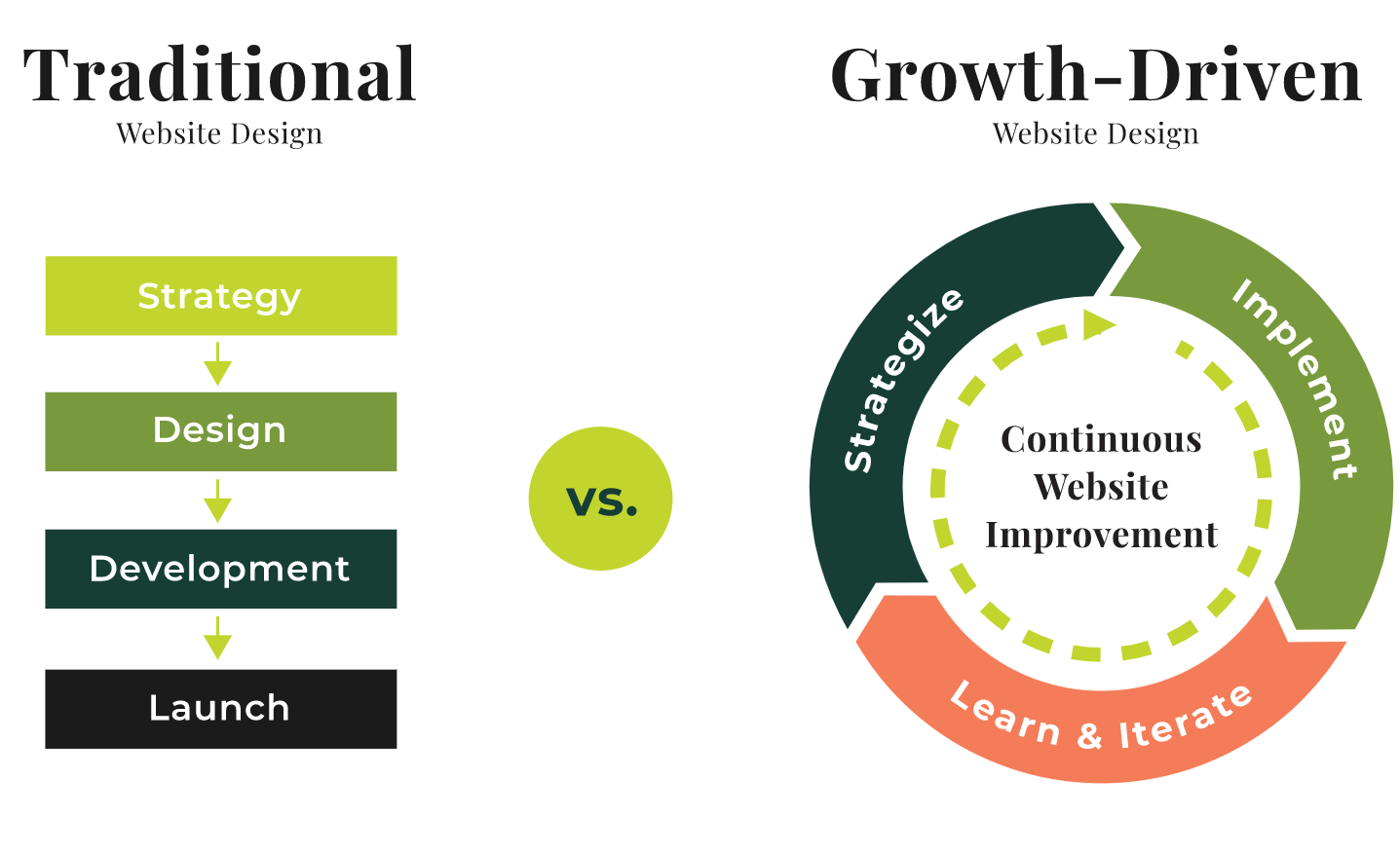
This Kanopi article on how to make a website last states: “Don’t think about your site in terms of Strategy > Design > Development > Launch, and then let it sit untouched for a while… Instead, think of a circular process of Strategy > Implement > Learn & Iterate, where after you Iterate, you revisit Strategy again! This will translate into a site that is always being refreshed and improved without breaking the bank.”
Here are some other benefits of taking a continuous improvement approach:
All of your website’s plugins, modules, and integrated tools are up-to-date and work seamlessly with each other
Your website is always fully accessible and compliant with all relevant laws
Users can more easily explore your website, learn about upcoming projects, and access your services
Every aspect of the donor journey, like mission research on your website, is seamless
You’ll see increased online conversions, like gifts, event registrations, and volunteer signups
You’ll set your nonprofit website up for long-term success, as your website health is much stronger when it’s constantly updated
Making small, minor tweaks on a more consistent and ad-hoc basis is more manageable time-wise and labor-wise than dedicating a large chunk of time to updating everything. And, this way there won’t be moments where users visit your site to learn something new and instead are met with outdated information or even broken pages or links.
When does your website need improvement?
So, now that you know why a continuous improvement approach to your nonprofit website is essential and how it can benefit your organization and goals, when exactly do you make those critical updates?
It’s not hard to determine exactly when your website could use a little love. Here is a list of questions to ask yourself:
Has your organization or mission evolved?
Do any of your software, tools, apps, modules, or plugins need updating?
Has your industry evolved? Are there any recent news updates you should share?
Can your users find what they are looking for? How navigable is your website?
Have your website visitors’ needs changed? Garner feedback through an email survey for more insight.
Is your content presented clearly? Is anything confusing?
Is your conversion rate declining? This can be the rate for online fundraising, event registrations, or any other organizational goals.
Have your search engine rankings changed? Has your landing pages’ bounce rates increased?
Have other similar nonprofit organizations changed their approach?
Is your site fast enough? A page speed of under 2-3 seconds is recommended.
Does your site look great on mobile devices? Is it compliant with other accessibility laws?
Is your site easy to use and edit? Can different staff members access and update content quickly and as needed?
If you answered yes to any of these questions, then it’s a good sign that your website could use some quick maintenance. Taking care of these needs immediately rather than waiting until the last minute is much more beneficial not only to your site’s health but also to your supporters’ user experience.
What are some website maintenance continuous improvement best practices?
Ready to start taking a continuous improvement approach to your nonprofit’s website maintenance? Here are some additional tips that we recommended:
Do a SWOT analysis of your website. This will help outline any strengths, weaknesses, opportunities, and threats you have to your site.
Map out user journeys to see how different users navigate through your site. Determine the different pathways they take and how you can improve your website to better align with these pathways.
Do a complete site audit to determine if your content is old or if there’s anything you need to update or archive.
Review major site components like your page architecture, overall design, site performance, and more.
Make small tweaks like removing links that people don’t click on, or archiving old content.
The most important part of your website maintenance plan is to always be open to learning and improving. As you continue to update and tweak your site, you’ll learn a little more about what works and what doesn’t.
Make it a habit to measure your site’s health and do data checks on a regular basis. You can even schedule user testing to make sure that your website is consistently meeting supporter needs. Work with your team to set up sprints to integrate this feedback into your site.
Wrapping Up
If you want to make your website last and ensure that your mission is a high priority, taking a continuous improvement approach to maintenance is your best bet. Don’t let your online engagements fall to the wayside and pile up your maintenance tasks to do at the last minute.
If you need any more guidance on how to track your website’s health and the small tweaks you should make, contacting a technology consultant for nonprofits can help.
About the Author:

As Founder and CEO of Kanopi Studios, Anne helps create clarity around project needs, and turns client conversations into actionable outcomes. She enjoys helping clients identify their problems, and then empowering the Kanopi team to execute great solutions.
Anne is an advocate for open source and co-organizes the Bay Area Drupal Camp. When she’s not contributing to the community or running her thoughtful web agency, she enjoys yoga, meditation, treehouses, dharma, cycling, paddle boarding, kayaking, and hanging with her nephew.
https://twitter.com/Anne_Kanopi
Using Google Grants Across Fundraising Streams: 3 Tips
Making the most of your organization’s Google Ad Grant across multiple fundraising platforms is crucial to reaching your engagement goals. Here’s how nonprofits of all sizes can diversify their revenue streams and specifically maximize the impact of their Google Grants.
Guest post by Grant Hensel, CEO of Nonprofit Megaphone
Nonprofit organizations are renowned for their ability to achieve great things with limited resources. Despite having tax-exempt status, being a nonprofit requires the pursuit of stable revenue streams. Often, this takes the form of fundraising. Successful nonprofits have a diverse range of fundraising activities, ensuring that their revenue isn’t tied to the success or failure of one particular venture.
Even if an organization has conducted a successful fundraising campaign for many years, these campaigns can stagnate. Stagnation, or the fear of stagnation, requires that nonprofit professionals find new ways to enhance and promote their fundraising efforts.
At Nonprofit Megaphone, we help nonprofit organizations share their mission with the world. To do this, we help organizations acquire, maintain, and utilize the Google Ad Grant. The Ad Grant is a cost-effective way for nonprofits to participate and thrive in digital marketing. While the Grant can be employed to achieve numerous goals, many of our clients use the Grant to boost the performance of various fundraising streams.
Simply put, the Google Ad Grant is an opportunity available to eligible nonprofits that give them a monthly allocation of Google advertising dollars. With the Grant, your organization will run Google Ads, which are sponsored links that appear in relevant web searches. These links are valuable, as your team can use them to drive traffic to your website. Further, using the Grant is often more efficient than traditional marketing, as you can use the data provided by Google to tweak and modify your ads for better results. We recommend the Google Ad Grant because it’s a cost-effective way to meet nearly any fundraising, marketing, or communications goal.
With our experience, we have three tips that will help you use the Google Grant to enhance your fundraising strategy:
Use KPIs To Determine Future Fundraising Strategies
Optimize Your Email Outreach
Build Out Content In Your Website To Make The Most Of Your Google Ad Grant
Use KPIs To Determine Future Fundraising Strategies
There are many ways for your organization to raise funds. However, determining which are worth your time and resources is a crucial strategic decision. Whether you’re looking to enhance your current strategies or looking for a new venture, a data-driven approach will be to your advantage.
The Google Ad Grant gives you access to a full suite of data and analytics tools in the Google Ads interface. Further, Google Ads easily integrates with Google Analytics, allowing you to analyze the performance of your ads in addition to your overall website performance. Using this data, you can identify where you’re having fundraising success and where you may be able to benefit from future investment.
Important metrics are called Key Performance Indicators. What qualifies as a KPI depends on your organization and its priorities, but there are a few important metrics for nearly every Google Ads Account.
Impressions
Impressions are one of the most common metrics in Google Ads. An impression is registered every time an ad appears in a Google Search. Impressions can tell you a lot about your ad’s performance but often need other metrics to see the bigger picture.
Strong impressions may indicate that your ad is relevant to a highly-searched topic, an essential part of any Google Ad campaign. However, if those impressions don’t lead to clicks, conversions, or other engagement metrics, it indicates that your Ad copy isn’t enticing enough. Even with good corresponding engagement metrics, low impressions may signify that the topic can only reach a narrower audience.
Clicks
A click is registered whenever someone clicks on your Google Ad and is taken to your website. As one of the most basic engagement metrics, clicks are an indicator of ad success. As such, tweaking your ads to generate more clicks is always a good thing. It’s also important to be mindful of your ad’s Click-Through Rate. This number is generated by dividing the number of clicks your ad generates by its impressions. Google requires that you maintain a 5% or greater CTR throughout your account. A higher CTR shows that your ads are operating efficiently, targeting the right audience and enticing them to engage with your organization.
Conversions
Of all engagement metrics, conversions are the grand prize. A conversion is registered any time a user makes an action of value on your website. In the context of fundraising, the act of making a donation, purchase, or other transaction would be a notable conversion. Using Google Analytics, you can set up conversion tracking and get detailed information about how users interact with your website.
In conjunction with Google Ads, you can learn which ads directly lead to fundraising conversions and prioritize those campaigns. With these KPIs, you’re able to learn more about your fundraising audience and what’s important to them. You can also gain insights into which audiences and topics should be targeted for future fundraising campaigns.
Optimize Your Email Outreach
Email outreach is an integral part of any marketing or communications campaign. Having a base of engaged email subscribers allows you to easily broadcast updates and opportunities to those who support your organization. Further, a solid foundation of email outreach can bolster existing fundraising streams and help launch new ones. There are a few ways the Google Ad Grant can help you grow your email list and identify what these users want from your organization.
Successful campaigns will track conversions that harvest email data. Your team can do this in a few ways but most commonly, in the form of a newsletter. Newsletters are a great way to spread your message, but also to keep stock of your engaged supporters. The Google Ad Grant can help grow your email list by driving users to pages where a newsletter sign-up is a prominent Call To Action on the page.
You can also gather email addresses in a few indirect ways. For example, you could require an email for other conversions that happen on your website. These conversions include:
Making a purchase
Downloading a file
Registering for an event
Users who make these conversions are unlikely to be dissuaded by entering their email address beforehand. Attaching email submissions to conversions is an efficient way to use your Google Ad Grant and enhance the overall effectiveness of your website.
Build Out Content In Your Website To Make The Most Of Your Google Ad Grant
Successful users of the Google Ad Grant have one thing in common: they consistently produce high-quality content that their audience wants to engage with. High-quality content is content that engages, interests, and is easily presented to a user. It leaves a mark in a user’s mind, often leading them to make a conversion or return to your site in the future.
Any site will benefit from high-quality content, but the Google Ad Grant can help drive traffic to the content. This increases the overall efficiency of producing content and gives you opportunities to introduce yourself to new users.
Good content will make users more likely to make conversions, some of which may be connected to valuable fundraising streams or necessary programs. Finally, the Google Ad Grant can give you a way to expand your audience by producing content that appeals to trending keywords or an underserved portion of your existing audience.
What constitutes high-quality content will differ between organizations depending on size, mission, or scope. However, things like videos, podcasts, and infographics are great candidates. For some organizations, users are looking for written content like blogs, essays, or Frequently Asked Questions. The key to producing high-quality content is identifying what your users want and presenting it to them in an easy, satisfying way.
Successful nonprofits will have a diverse set of programs and fundraising streams. This allows them to adapt, change, and grow as conditions develop in their communities. However, getting the most out of these strategies requires an investment in marketing to grow and maintain their audience.
The Google Ad Grant is an affordable and flexible way to maximize the value of your nonprofit’s existing investments. Taking advantage of the advertising provided by the Google Ad Grant allows your organization to identify better where your fundraising streams are having the most success and where further investment is necessary. If your organization is running successfully but wants to maximize efficiency, consider applying for the Google Ad Grant yourself or by consulting a marketing agency.
About the Author:

Grant Hensel is the CEO of Nonprofit Megaphone, an agency focused 100% on Google Grant Management for nonprofits. NPM is honored to manage the Google Grant for 370+ leading nonprofits worldwide and to be an inaugural member of the Google Ad Grant Certified Professionals community.

Nonprofit Marketing: 3 Tips for Tuning in to Donors
Tuning into your donor base has a host of benefits for your marketing strategies. Find out three helpful tips for doing this task in the most effective way.
For nonprofit teams, communicating with potential supporters about how they can get involved is obviously very important to the survival of the nonprofit organization - but sometimes, it can be difficult to know where to start. Grant Cobb, Head of Marketing and Analytics at GivingMail, dives in with three actionable tips for maximizing impact in your nonprofit communications.
Looking for the best way to reach your target audience? When promoting your organization with a cohesive marketing strategy, you’ll want to tune into what you know about your donors already to connect with them effectively.
This may seem like a challenge to undertake as an organization. However, you already have most of the information you need to make intelligent decisions for your marketing strategy. GivingMail knows that marketing for nonprofit organizations helps your team gain access to invaluable engagement data and can help you make even more targeted appeals and outreach content.
Ready to simplify the process of tuning into your donors for a more pointed marketing strategy? Let’s unpack the following tips:
Use your data to create donor segments.
Offer multiple ways to get involved.
Track your donor engagements per platform.
We’ll start with one of the essential sources for learning more about your donors, using your database to create donor segments.
Use your data to create donor segments.
Donor segmentation is the process of dividing your existing constituents into subgroups according to shared traits.
This practice is essential for tuning into your donor base and understanding your audience to the best of your ability. You can use these groups to determine trends and insights from the best outlet for sending out targeted communications to the opportunities that excite different groups.
Luckily, a lot of this information is available in your CRM and the donor profiles within your donor database. However, many nonprofits struggle with finding somewhere to start. After all, you hold a large amount of information on your database. Here are some categories to begin your segmentation process with basic demographics:
Age
Household size
Location
Interests
This way, you can begin to make crucial insights according to what may interest them. You’re able to determine which outreach will resonate with them and predict further actions. For example, if your donor is located in your area, you can send them information about in-person events that they can easily attend.
Once you have basic information about your constituents, you can start to tune into how they have directly engaged your organization. Take note of the following types of questions:
How do they give to your organization?
How did they find out about your organization?
Have they volunteered in the past?
Which campaigns did they give to?
From these helpful insights, you can begin to fine-tune how you reach out to donors and simplify their donor journey based on past giving data. For example, if you determine the most popular route for your donors is through direct mail, you can implement this insight into simplifying their experience.
This way, you can choose the best marketing channels for your target audience.
Based on your social media engagement and messaging information, you can begin to answer the following:
What social media platforms are they using?
Have they replied to any direct mail outreach?
Are they opening your emails?
Again, your organization’s donor segmentation process will be different for every nonprofit, as they’re dependent on how available and in-depth the information is that you collect. Now that you’ve developed helpful subgroups, begin to adjust your marketing strategies as such to resonate with your audience in the best way possible.
Offer multiple ways to get involved.
Your donor data, as mentioned above, can provide crucial insights into how to involve your donors with your mission best. After you’ve nailed down the initial segments by general demographics and involvement, consider the ways donors give to your cause. Then, meet them where they are to maximize their impact on your mission.
To get started, look into your donor’s engagement history in your CRM. Here are a few of the most common ways individuals can engage with your nonprofit:
Monetary donations: These are any sort of cash or online donation. These are the donors you’ll reach out to when hosting an annual fund campaign, are raising money for a specific cause, and anything having to do with writing a check to your organization.
In-kind donations: These donors give valuable products or services to your organization. This can be from a company, an individual, or a trust. For example, if your team is hosting an upcoming charity event, search for product donations or auction items to make the event as successful as possible.
Time: Separate your donors by those who have contributed time to your cause. This group will most likely be the audience you’ll turn to when you are in need of volunteers to show up for your organization in person or virtually to help facilitate a fundraising event or other gathering.
Promotion: Make a note in your donor profiles whenever someone shares your organization’s content on their social media feeds. You’ll know who to depend on if you ever need to ask a group of supporters to promote your posts further to their networks of followers.
By tracking your donors and their engagement history, you can begin to clarify your strategy on meeting them where they are. According to GivingMail, asking for donations should be tactful based on previous engagements. You can even maximize your donations with a few pointed questions like these:
How are you asking for donations?
What are you requesting from each group to push your mission forward?
Who are you asking for support, and why?
When your organization begins to tune into donors based on their willingness and preferences to give, you can easily meet their needs where they are. Let’s get into the final metric to track when making insights about your donors: your platform KPIs.
Track your donor engagements per platform.
Finally, your team can clarify its outreach strategy by paying attention to your social media KPIs. According to these social media insights, social media marketing is a preferred platform for nonprofits due to its cost-efficiency and ease of content distribution to supportersYour team can determine a few things about your donor audience per your social media platforms. Namely, you’ll have an inside look into:
The most popular platform for reaching your audience.
When your donors are seeing your content.
Which outreach methods are most effective for your donors.
As a result, It’s likely that your marketing strategy can most effectively reach donors with a multi-channel approach. To get a better read on your donors and their behaviors, you’ll want to post content on multiple channels for the best results. Let’s take a look at how each platform can help you learn more about your audience:
Instagram: Determine who, where, and when your supporters are interacting with your content. You’re also able to see who views your 24-hour stories and if it’s the most effective way to make quick updates to your audience.
Facebook: This social media platform can alert your organization to who is responding to your Facebook fundraising events most often. More importantly, you’re able to see who is sharing your content to their Facebook feeds and which posts resonate most with those who are sharing.
Twitter: This short-form post social media platform can alert your organization to how quick updates are resonating with your followers. Look into the retweets and favorites on each post and determine if this is an effective route for communicating with donors.
From these KPIs, refine your social media strategy to communicate with donors in the most effective way possible. Be sure to create donor segments based on the most popular social media platforms for your supporters, and plan accordingly to reach them.
When you begin to tune into your donors with the rich and hard-earned data your organization has retained through events, outreach, and online engagements, your team benefits heavily. Use data to create accurate insights about your supporters, clarify your strategy, save time, and meet your donors where they are. Good luck!

Raffle Fundraisers: New Year, New Compliance Requirements?
Key changes to raffle fundraisers and nonprofit compliance in 2021. Have you kept up on recent updates?
In 2020, the California Attorney General’s office updated forms relating to charities and nonprofits, which includes newly updated Nonprofit Raffle Annual Registration and Reporting (CT-NRP-1 and CT-NRP-2). Even if you are not based in California, don’t forget to check with the governing body in your own state (or province) to ensure that your fundraising practices, registration (if needed), and reporting are compliant.
The California Attorney General’s Nonprofit Raffles Frequently Asked Questions hold good reminders about:
Determining whether you have an “eligible organization”
How to register with the Attorney General's Registry of Charitable Trusts before the raffle
The importance of September 1
The 90/10 rule
Required recordkeeping and reporting deadlines
How raffle proceeds are allowed to be used (in California it’s within the state only, per Penal Code section 320.5, subdivision (b)(4)(A))
There’s even a Raffle Registration Checklist to make it easier to be compliant.
If your organization plans on holding a raffle or other fundraiser, we highly recommend doing an annual review to make sure the rules haven’t changed!
Disclaimer: This article is not intended, nor should it be received, as legal advice. Please consult with your own legal advisors regarding your own situation.